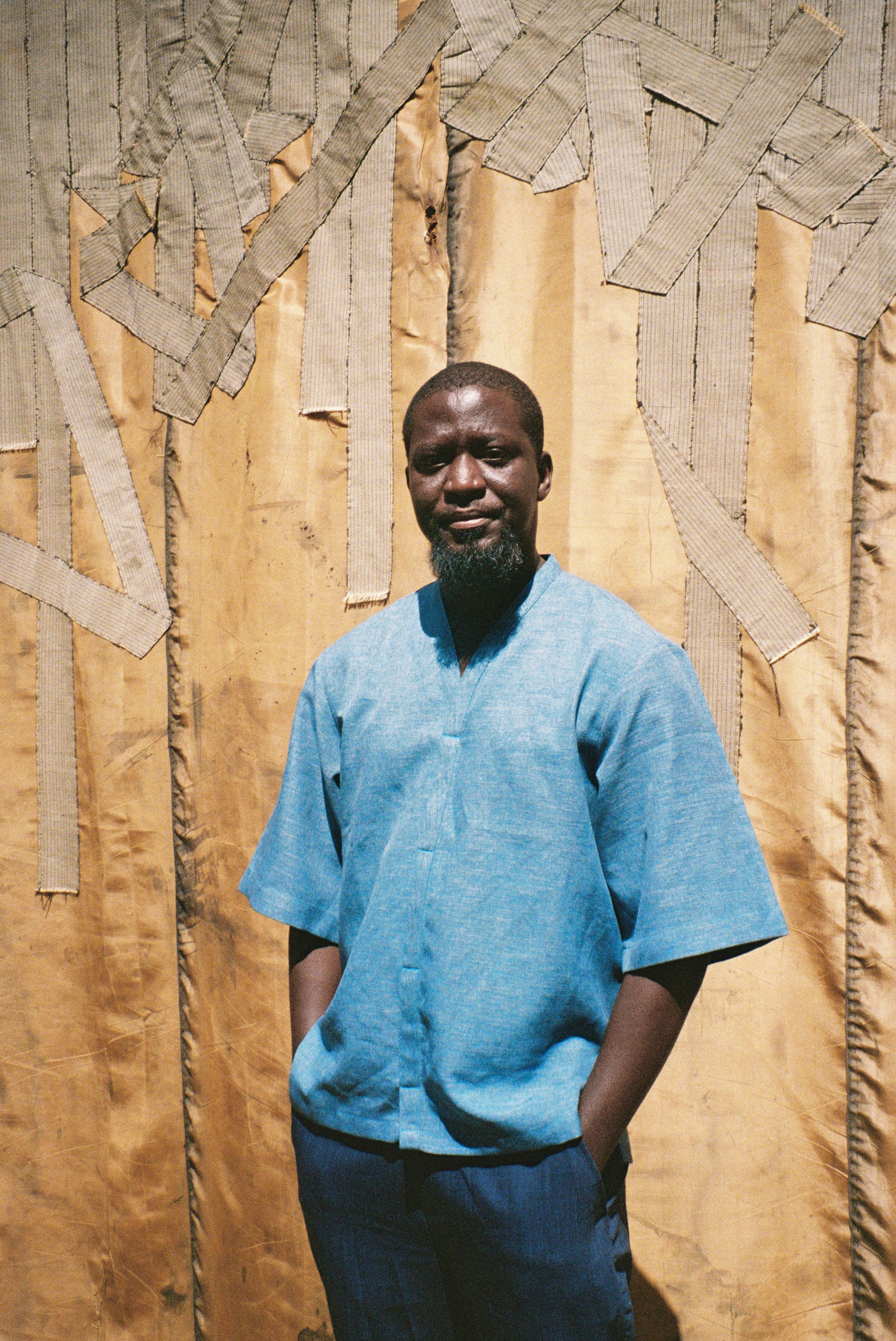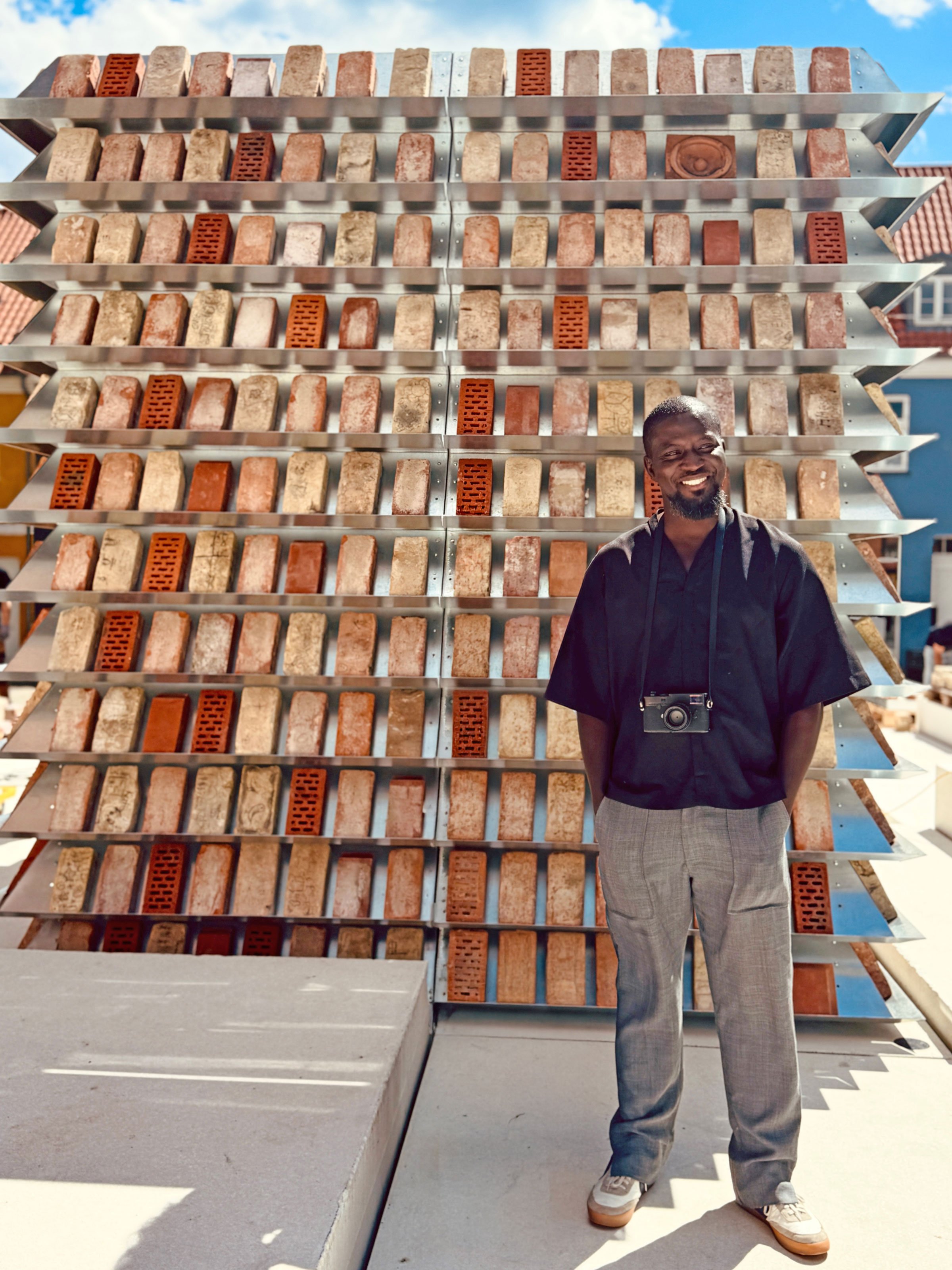
Ghanaian artist Ibrahim Mahama works with objects that have already had a life: jute sacks, metal bowls, aeroplanes, hospital beds and bricks. In his hands, they become ways of tracing the people, labour and global networks of trade that have moved goods and value across the world, and the colonial histories that continue to shape those systems today.
Success in the art world has long been measured in exhibitions, biennials and museum collections. Ibrahim Mahama has taken a different path. In 2025, ArtReview placed him at the top of its annual ranking of the most influential people in the art world. The recognition pointed to something larger than his international prominence: a practice that challenges the art world’s established circuits and expands the very idea of what an artist can create.
Mahama grew up in Tamale and studied at Kwame Nkrumah University of Science and Technology (KNUST), where he became part of blaxTARLINES, an artists’ collective founded on the idea that art can be shared, circulated and used to create new communities. That thinking has since taken his practice far beyond the individual artwork, into buildings, archives, education and institution-building.
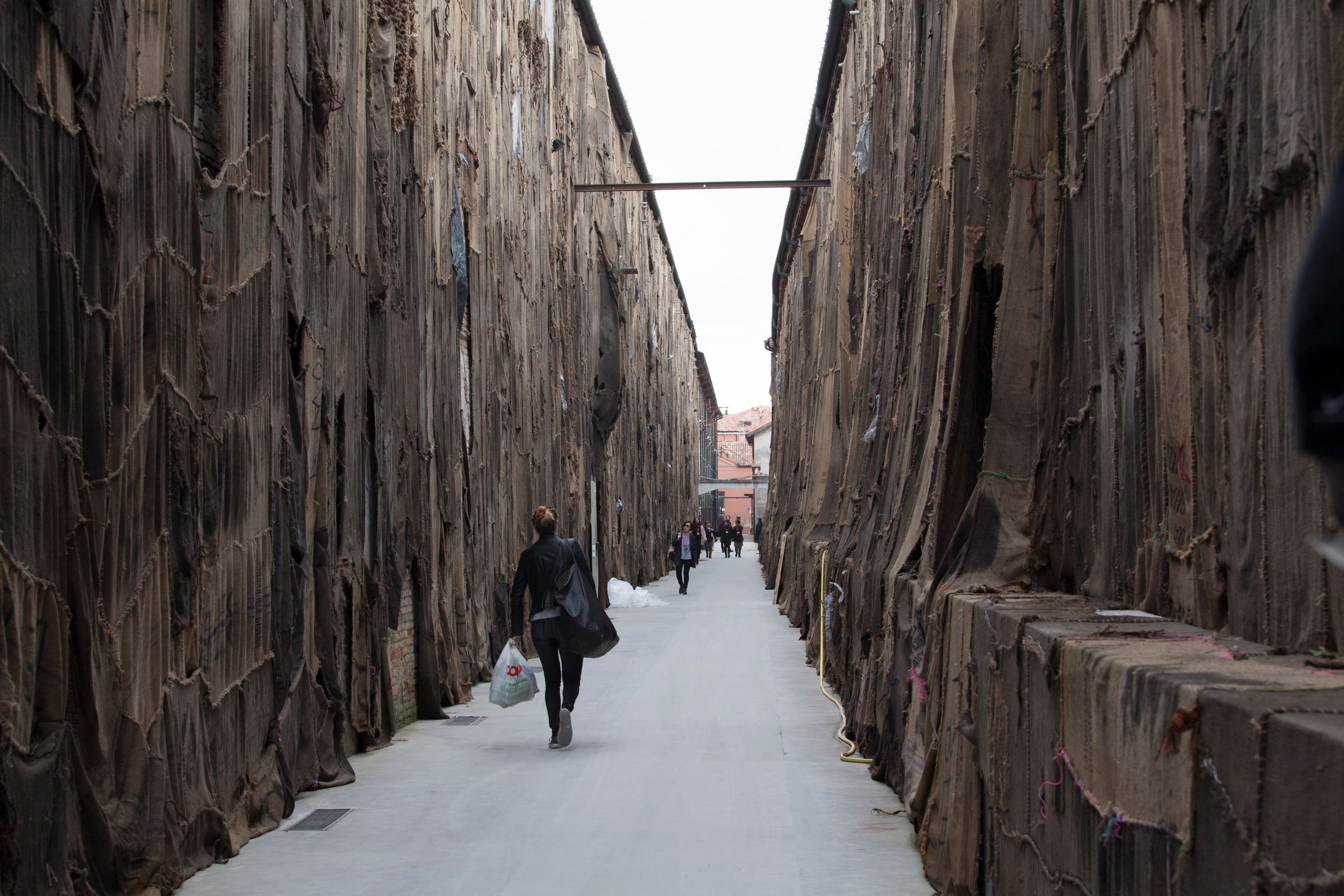
The 56th Venice Biennale in 2015 had the theme All the World’s Futures. Ibrahim Mahama participated with his installation Out of Bounds, made from used jute sacks once used to transport coal. Photo: Haupt & Binder. Courtesy of the Artist and APALAZZOGALLERY
He has wrapped the Venice Biennale’s Arsenale (2015) and the monumental former customs buildings of Porta Venezia in Milan (2019) in jute sacks, and filled Kunsthalle Wien with locomotives, railway components, headpans and X-rays in Zilijifa (2025). Over the past decade, Mahama’s work has occupied some of the art world’s most prominent stages.
Over the past decade, Mahama has channelled the visibility and resources afforded by the international art world into building a cultural infrastructure in northern Ghana. He has established Red Clay Studio, the Savannah Centre for Contemporary Art (SCCA) and Nkrumah Voli-ni, where silos, trains and aeroplanes have been transformed into exhibition spaces, archives, workshops and places of learning.
In a region where access to arts education is limited, artists, craftspeople, researchers and local communities work alongside one another, while new generations are given opportunities to make, learn and engage with art. Art made here travels out into the world, then returns in new forms and contexts.
Mahama’s works often begin with materials and objects that have already passed through other hands: jute sacks once used to transport cocoa and other commodities, decommissioned trains, hospital beds, sewing machines, metal bowls, aeroplanes and bricks. Their wear, markings and repairs reveal something of the people and systems that produced, transported and used them, connecting individual objects to larger histories of labour, migration, colonialism and global trade.
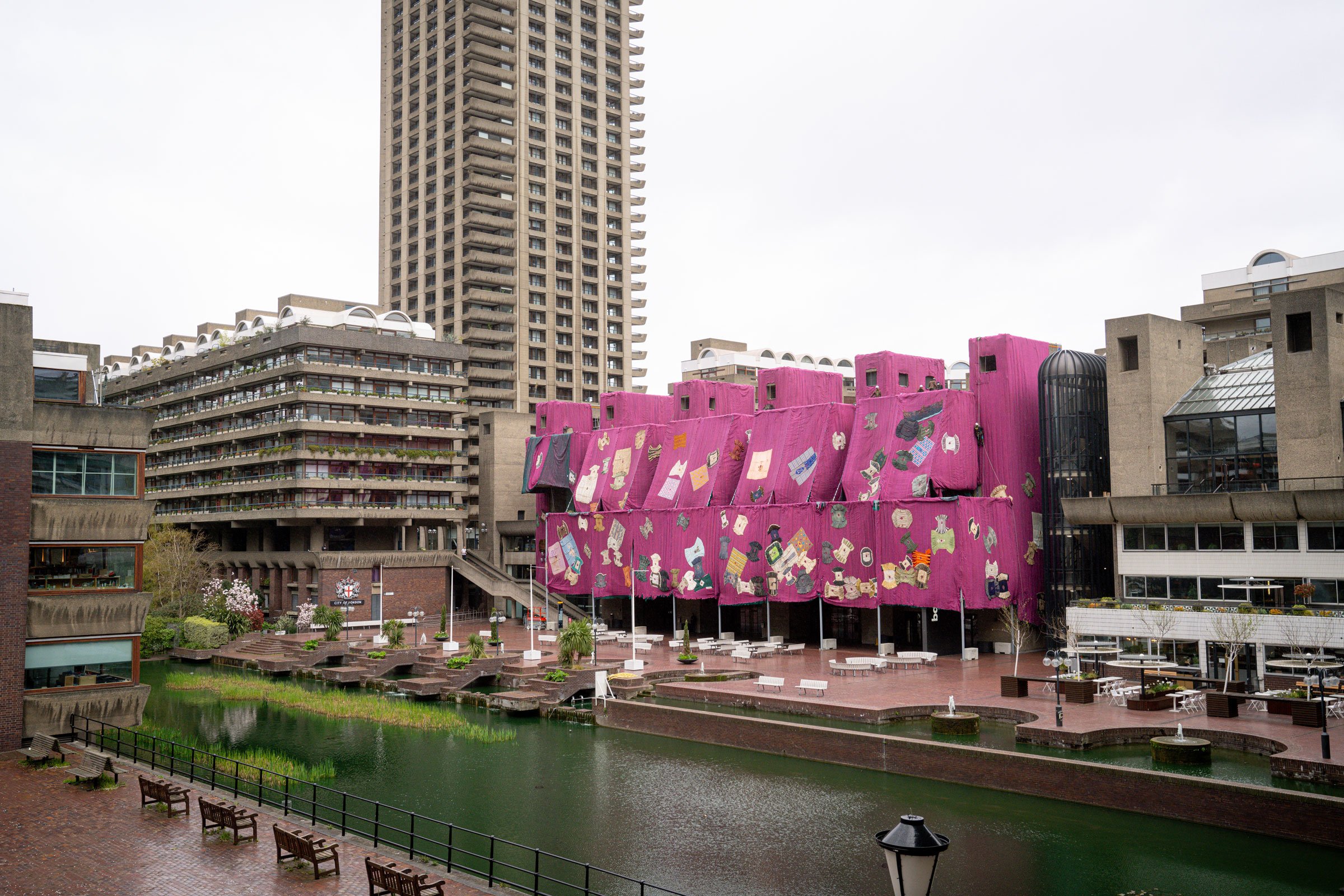
Ibrahim Mahama’s Purple Hibiscus installed on the concrete facade of the Barbican Centre, 2024. Courtesy of Ibrahim Mahama, Red Clay Tamale, Barbican Centre, London, and White Cube. © Pete Cadman, Barbican Centre
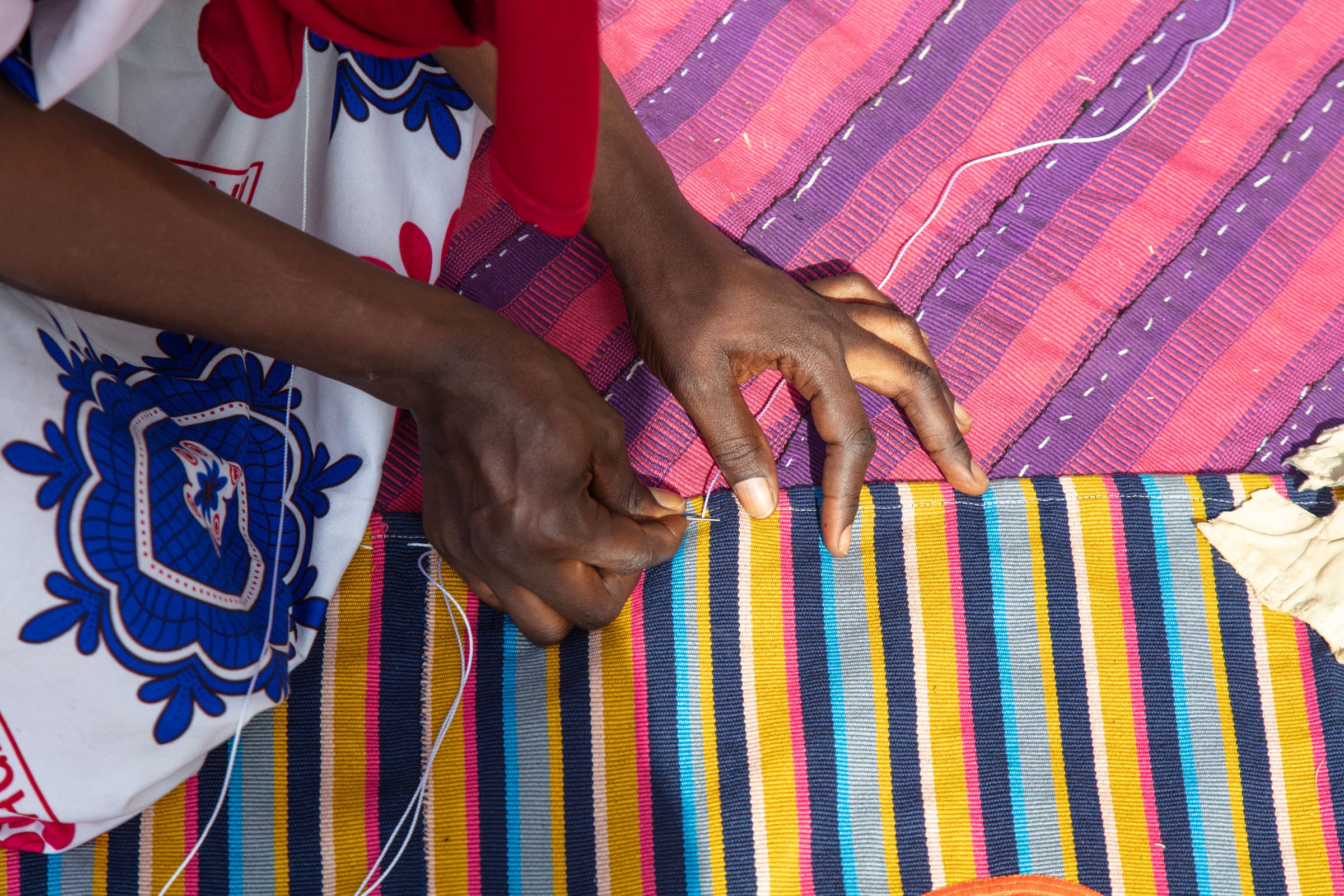
Ibrahim Mahama: Purple Hibiscus, 2023–24. More than 1,000 weavers created the work for the Barbican Centre. Courtesy of Ibrahim Mahama, Red Clay Tamale, Barbican Centre, London, and White Cube
When Purple Hibiscus (2024) spread across the Barbican Centre’s iconic concrete façade in London, its story had begun almost 6,000 kilometres to the south, in Tamale. There, more than 1,000 weavers and craftspeople wove and stitched the 2,000-square-metre textile, much of it assembled in the city’s stadium before being transported to London. The Barbican, one of Britain’s most distinctive cultural landmarks, was built between 1965 and 1982 on a site devastated during the Blitz, its hand-worked concrete still bearing the imprint of the labour that went into its construction. Named after Chimamanda Ngozi Adichie’s novel and incorporating more than a hundred batakari garments collected through a decade of exchange in northern Ghana, Purple Hibiscus brought the hands behind the textile into dialogue with the hands behind the concrete.
When Mahama’s work arrives in Denmark in 2026, a different history comes into view. Denmark and Ghana have been connected for centuries. From 1659 to 1850, Denmark maintained forts and trading posts on the Gold Coast, in present-day Ghana. Danish merchants traded in commodities including gold and ivory, and later enslaved people who were transported across the Atlantic to the Danish colonies in the Caribbean. Fort Christiansborg, now Osu Castle in Accra, remains a physical testament to almost two centuries of Danish presence on the Ghanaian coast.
Mahama created his first major work in Denmark in 2016, when Nyhavn’s Kpalang transformed the façade of Kunsthal Charlottenborg overlooking Nyhavn. Thousands of used jute sacks, themselves shaped by cycles of trade and transportation, were stitched together across the historic building. The histories carried by the sacks entered into dialogue with those of Copenhagen itself. For centuries, Nyhavn had been at the heart of the city’s maritime trade, placing the sacks from Ghana within an urban landscape historically connected to West Africa and the transatlantic economy.
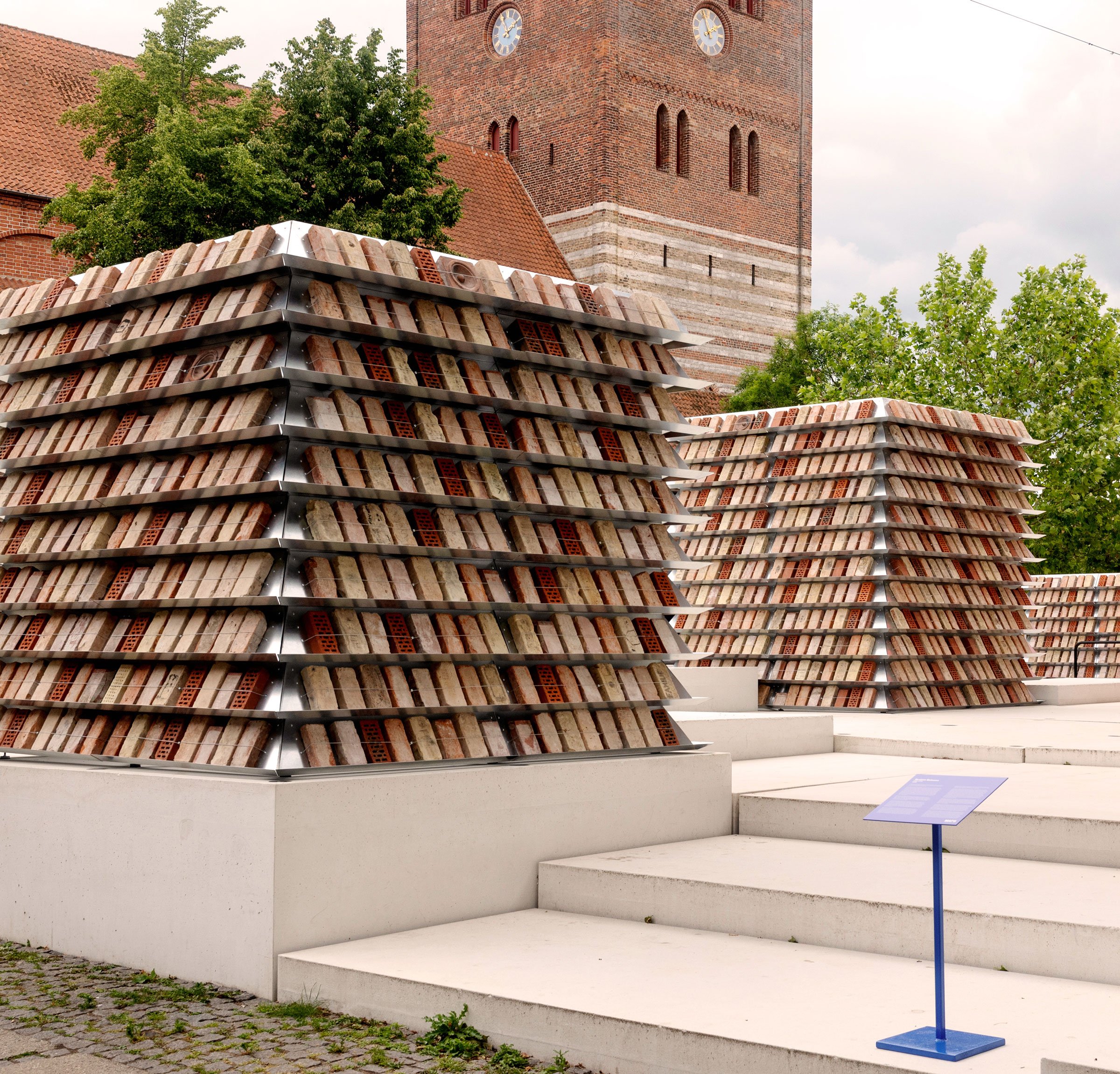
Ibrahim Mahama’s installation Labyrinths can be found in front of MAPS – Museum of Art in Public Spaces in Køge. Photo: Tilde Døssing Tornbjerg. Courtesy of the Artist, MAPS, APALAZZOGALLERY and White Cube
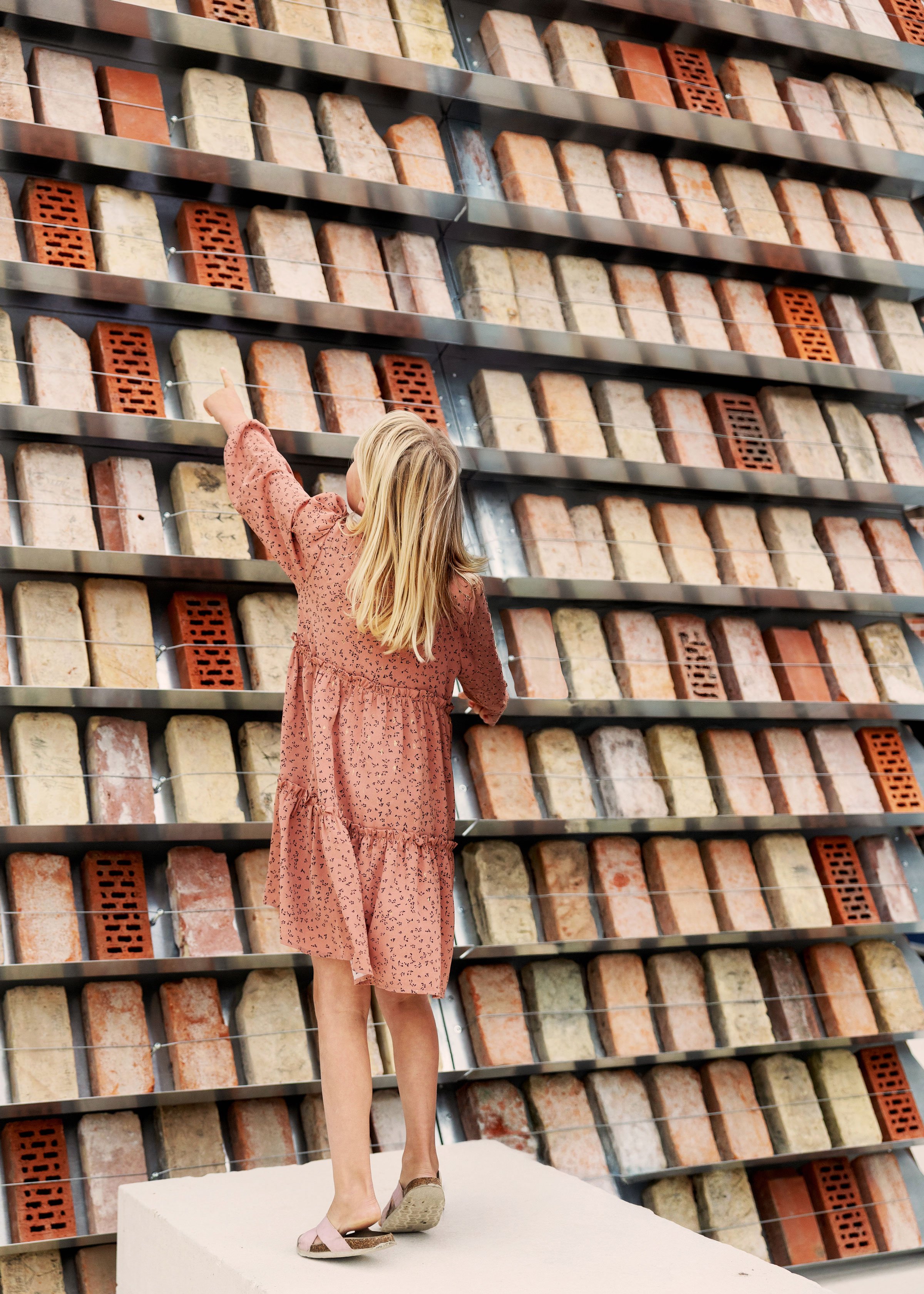
A girl in front of Ibrahim Mahama’s installation Labyrinths at MAPS in Køge. Photo: Tilde Døssing Tornbjerg. Courtesy of the Artist, MAPS, APALAZZOGALLERY and White Cube
Ten years later, Mahama returns to Denmark with Labyrinths at MAPS – Museum of Art in Public Space in Køge, curated by senior curator Kit Leunbach. Where the jute sacks at Charlottenborg had circulated through Ghana’s trading economy, this time Denmark itself became the material.
Labyrinths is constructed from thousands of reclaimed bricks from Fredensborg Palace, Vestre Prison, the Natural History Museum of Denmark, the Convent of Our Lady and MAPS itself. Fragments of buildings associated with monarchy, religion, punishment, science and education are dismantled from their original contexts and brought together to form a new public landscape.
More than a thousand schoolchildren from Køge have written and drawn directly onto the bricks, creating a collective archive of their stories and hopes for the future. Bringing these contributions together with bricks carrying their own institutional histories, Labyrinths asks who gets to shape our shared history, and how the material remains of the past might become part of imagining what comes next.
Art Matter met Ibrahim Mahama at MAPS in Køge to talk about the historical ties between Ghana and Denmark, the memory carried by materials, and the place and responsibility of art in society.
In Labyrinths, every brick has already lived several lives before becoming part of the work at MAPS. At what point does an object become a bearer of history?
"I don't think materials become historical witnesses only when they enter a museum or an artwork. They begin accumulating history from the moment they are extracted, produced, transported and touched by different lives."
"Every material carries evidence of labor, of movement, of systems of exchange and of time. A brick is never simply a brick. It has already belonged to a landscape, to a factory, to a building, to someone's work, and eventually to decay."
My role is not to give materials a history but to create the conditions in which their histories can be read again.
Ibrahim Mahama
"My role is not to give materials a history but to create the conditions in which their histories can be read again. When different materials meet within the work, they also bring together different temporalities. The artwork becomes a place where these histories remain active rather than fixed. Materials continue to testify because they continue to change."
The schoolchildren’s hopes for the future are written onto these historic bricks. Why is it important to you that an artwork remains open, even after it is finished?
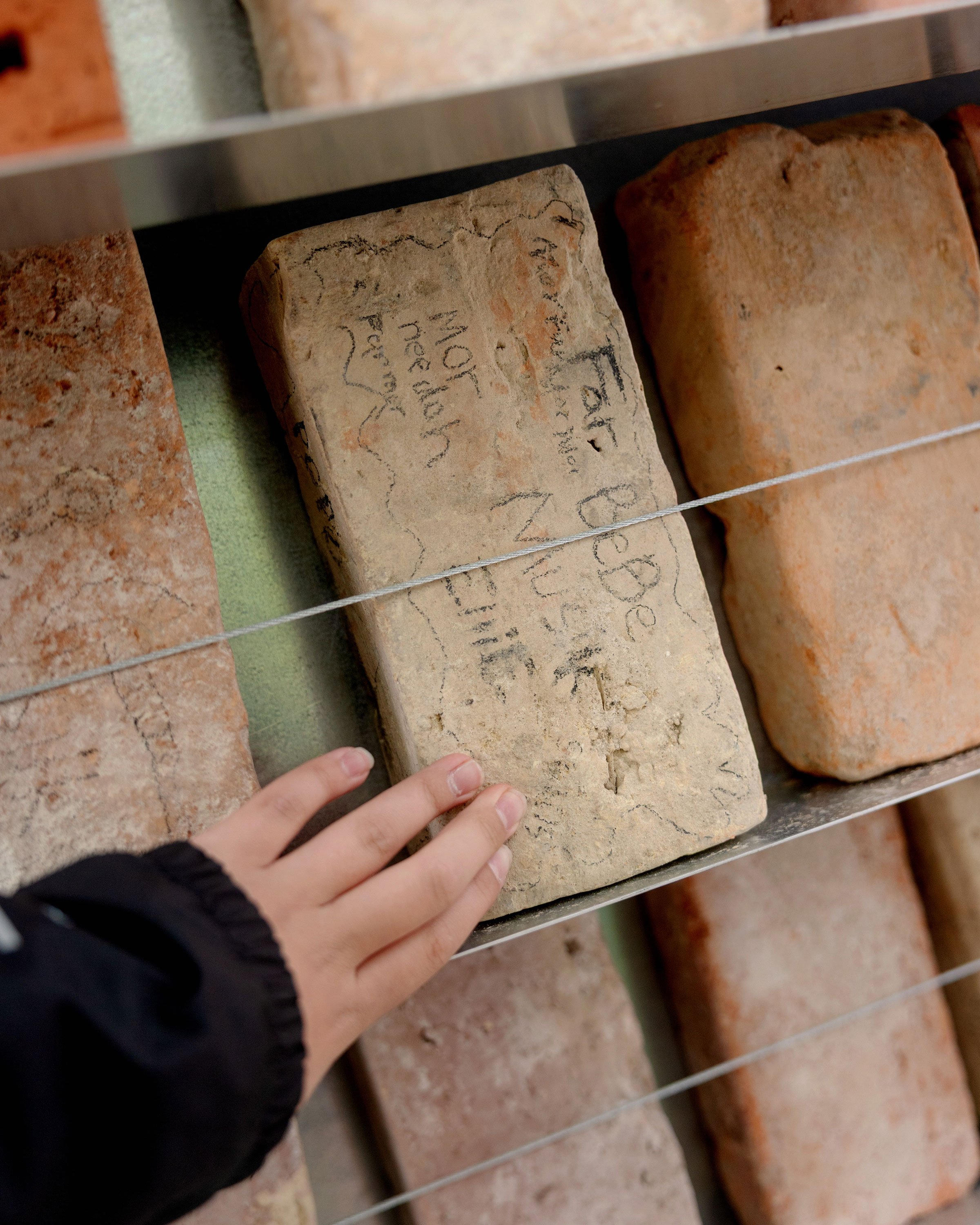
Schoolchildren from Køge have written and drawn their hopes for the future on the bricks. Photo: Tilde Døssing Tornbjerg. Courtesy of the Artist, MAPS, APALAZZOGALLERY and White Cube
"A work should never close itself upon completion. If it is alive, it must remain capable of receiving new experiences and new memories. The participation of the children is not simply symbolic. It allows the work to extend beyond my own authorship and beyond the historical narratives that produced the materials. Their drawings and words introduce futures that none of us can fully anticipate."
"I often think that history is not only what we inherit but also what we prepare for those who come after us. When different generations leave traces within the same material, the work becomes less about preserving the past than about negotiating a future collectively."
Museums often preserve objects by removing them from their original context. In your work, you give them another life. What might museums learn from this?
"Preservation should not always mean isolation. Many objects survive precisely because they continue to circulate, to be repaired, to be reused and to acquire new meanings. Once an object is separated completely from life, it also loses part of the knowledge embedded in its use."
"Perhaps museums can think of themselves not only as places of conservation but also as places where objects continue to produce relationships. Repair, maintenance and reuse are also forms of preservation. Sometimes allowing an object to remain active protects more than trying to freeze it in a single historical moment."
Jute sacks have become one of the defining materials of your practice. What did you see in them that others might have overlooked?
"I was never interested in the sacks because they were visually extraordinary. I was interested in everything that had already happened to them before I encountered them. They had travelled across continents carrying cocoa, charcoal, food, minerals and many other commodities. Every repair, every stain and every stamp recorded another stage in those journeys. The sacks reveal invisible infrastructures. They expose the labour that sustains global economies while remaining largely unseen."
Rather than concealing repairs, wear and cracks, you draw attention to them. What can these marks tell us?
"When we think about something that requires repair, we often begin from the idea of a critical condition: something that has been damaged, weakened, broken or affected by time. But for me, repair is not simply about returning something to an earlier state. It is a way of acknowledging that every object passes through time, and that time itself becomes part of its existence."
"The marks of use, fractures, stains and repairs are not imperfections to be erased. They are forms of knowledge. They reveal the labour that has passed through a material, the people who have interacted with it, and the social and economic conditions that have shaped its existence."
"A repaired object becomes a kind of palimpsest: it carries layers of its own history even as it enters a new phase of life. I am interested in repair as an act of care rather than a response to failure. In many situations, damaged things are abandoned because they are considered disposable."
"Repair resists this logic of disposability and insists instead on the continued relevance and value of what might otherwise be discarded."
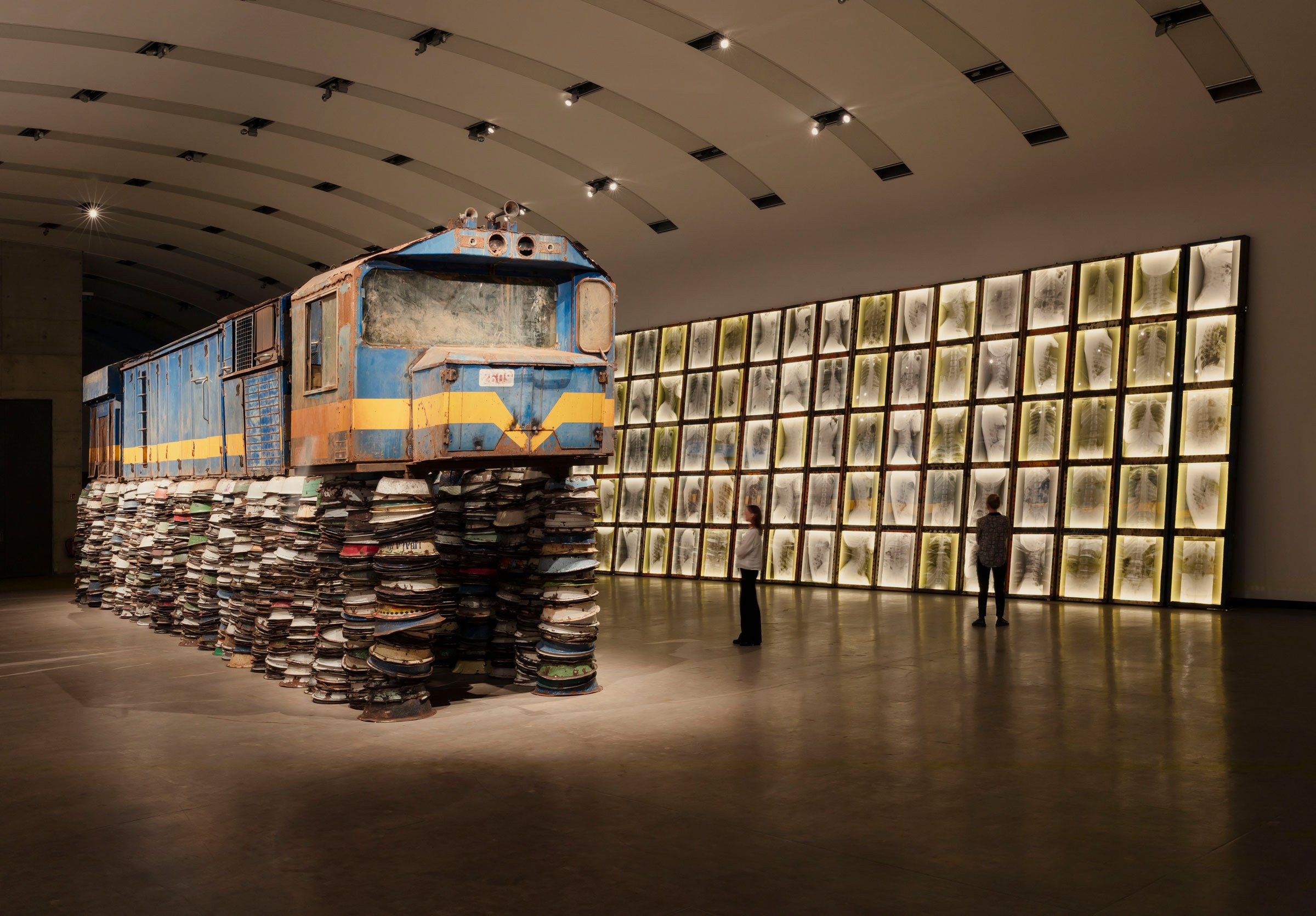
Ibrahim Mahama: Zilijifa, Kunsthalle Wein, Vienna, Austria, 2025. © Ibrahim Mahama. Photo: Markus Wörgötter
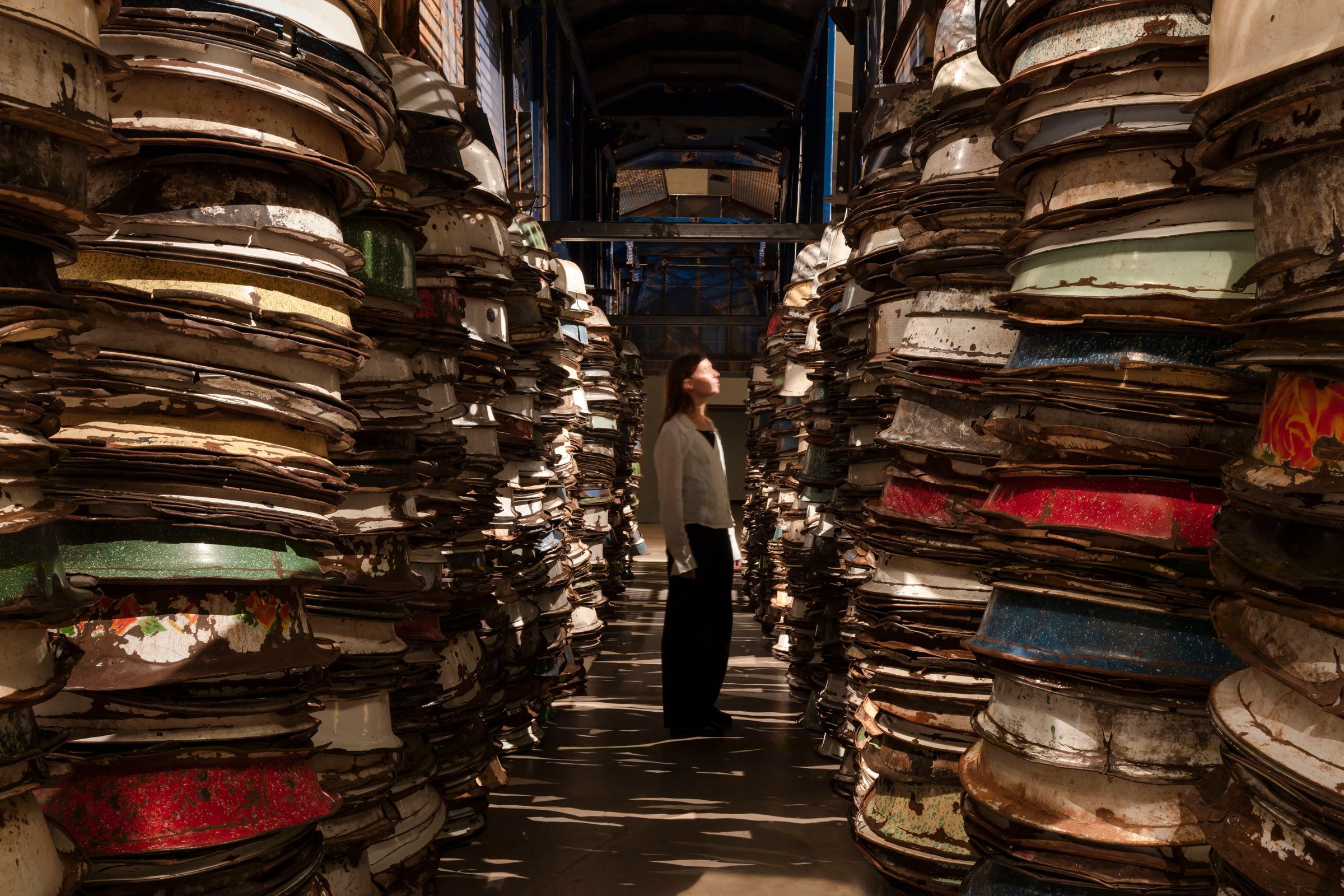
Ibrahim Mahama: Zilijifa, Kunsthalle Wein, Vienna, Austria, 2025. © Ibrahim Mahama. Photo: Markus Wörgötter
"In my work, repair also has a collective dimension. It often involves artisans, mechanics and communities who contribute their own forms of knowledge to the process. It is not only about restoring the physical integrity of an object, but also about recognising the forms of intelligence contained in people's hands and everyday practices. Repair does not mean returning to the past. It means allowing a thing to carry its past into a different future."
Zilijifa at Kunsthalle Wien brought together locomotives, railway components, headpans and X-rays to explore labour and the physical weight of history. What questions did that exhibition allow you to ask that earlier works could not?
"The exhibition allowed me to think about weight in a more literal and bodily way. Railways are systems built to move immense loads, yet behind every infrastructure there are bodies carrying invisible burdens. The headpan, for example, compresses an entire history of labor into a single object."
"Introducing X-rays shifted the conversation further. They suggested that history also leaves traces inside the body, not only within architecture or machinery. I became interested in how extraction, labor and movement shape both physical landscapes and human anatomy. The exhibition expanded my understanding of repair beyond objects to include the body itself."
Red Clay Studio, the Savannah Centre for Contemporary Art (SCCA) and Nkrumah Voli-ni are institutions in a constant state of change. Why is it important to you that an institution is never truly finished?
"Yes. I think unfinishedness is a condition of life. Once an institution believes it has reached completion, it risks becoming detached from the realities surrounding it. An unfinished institution remains capable of listening. It can accommodate unexpected collections, new collaborations and changing communities. It also accepts that knowledge is always incomplete."
"I see construction and repair as continuous processes rather than separate moments. In that sense, the institution itself becomes another material under constant transformation."
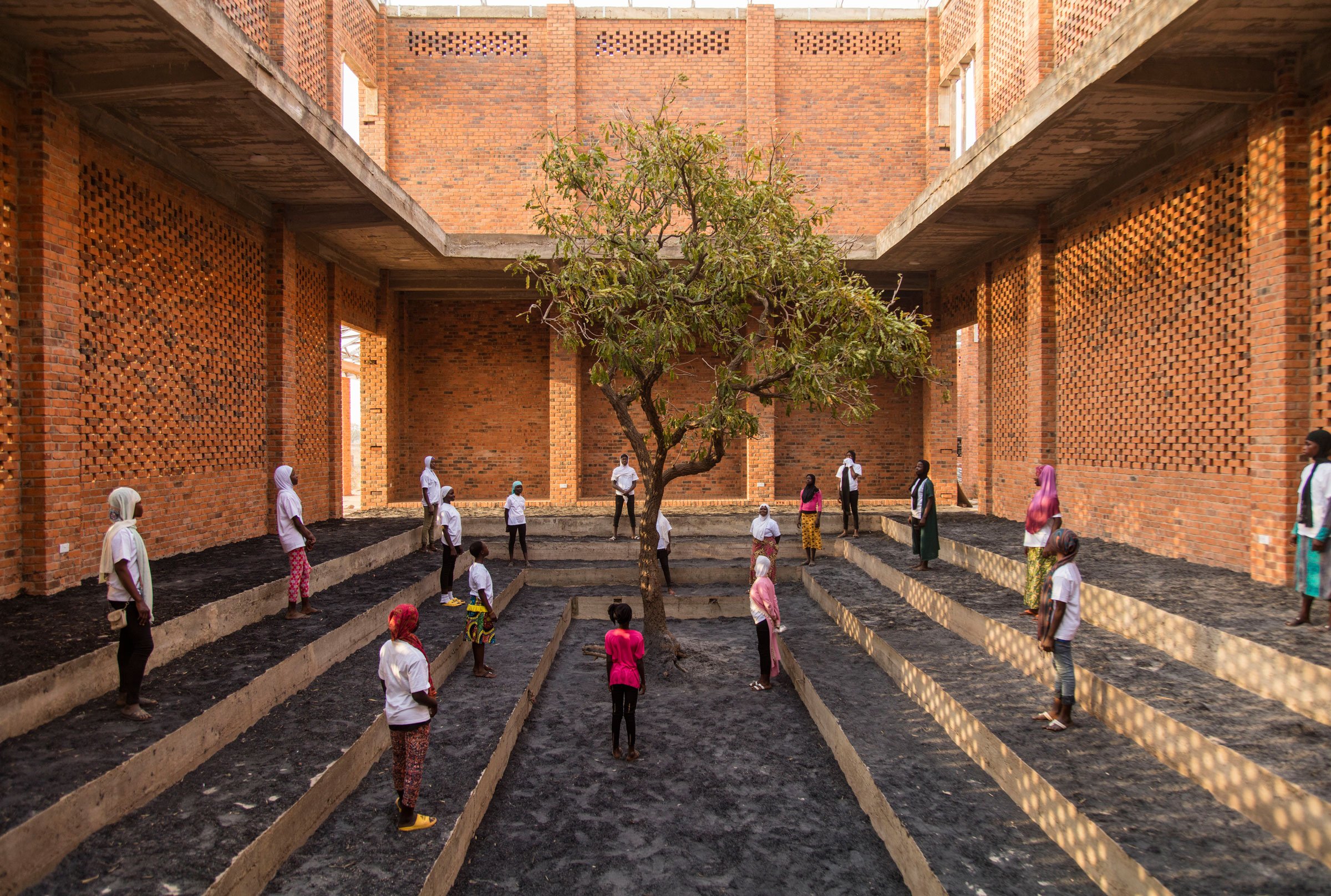
Red Clay: Witnesses, Ass, shea tree and the parliament. Photo: Ernest Sackitey Courtesy of SCCA and Red Clay
Art should make visible what has remained invisible while leaving space for multiple interpretations.
Ibrahim Mahama
What responsibility do artists have today for the histories that are written and preserved?
"Artists cannot replace historians or archives, but they can expand what we recognize as an archive. Buildings, roads, machines, fabrics and everyday objects all preserve histories that official records often overlook."
"I think the responsibility of artists is to create new ways of encountering those histories without fixing their meaning."
"Art should make visible what has remained invisible while leaving space for multiple interpretations. It should also ask who has been excluded from historical narratives and how other forms of memory can continue to exist alongside official accounts."
About Ibrahim Mahama
Ibrahim Mahama was born in 1987 in Tamale, Ghana. He lives and works in Accra and Tamale. He studied at Kwame Nkrumah University of Science and Technology (KNUST) and is a member of the artists’ collective blaxTARLINE.
In 2025, Ibrahim Mahama became the first artist from the African continent to top ArtReview’s Power 100. In 2019, Mahama opened the Savannah Centre for Contemporary Art (SCCA) in Tamale – a museum run by a group of artists and curators based in Ghana. In 2020, he opened the studio and production complex Red Clay, followed by Nkrumah Voli-ni in 2021.
Mahama is represented by APALAZZOGALLERY in Brescia, Italy, and White Cube in London, England.