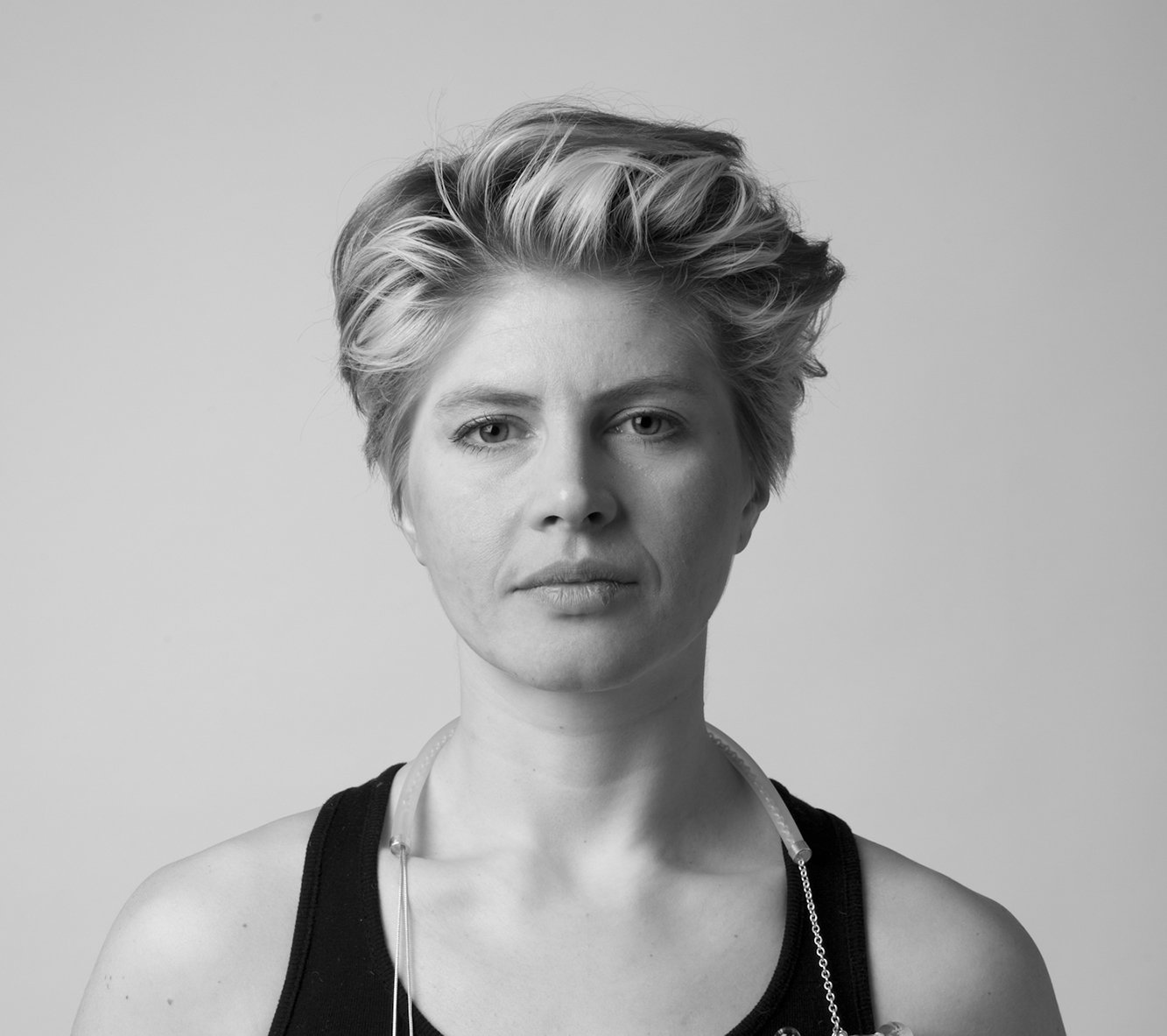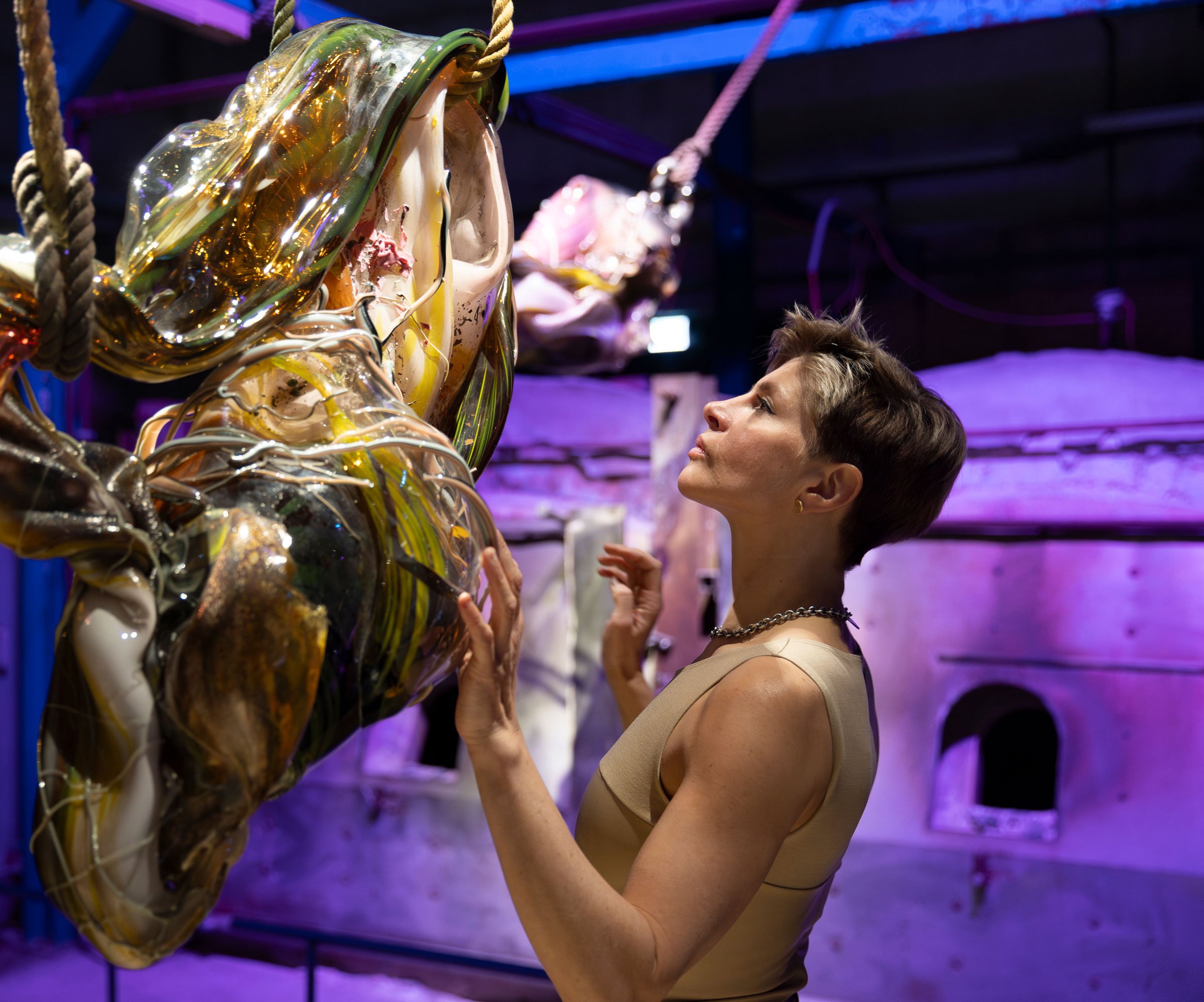
Maria Koshenkova makes glass behave like a living body – stretched to its limits, resisting, yielding, on the verge of collapse. Her sculptures are muscular, marked by pressure, time, and force. Nothing holds. Everything is in flux.
When the glass begins to respond in return
Born in Russia and educated at the Stieglitz Academy in Saint Petersburg and The Royal Danish Academy – Glass & Ceramics in Copenhagen, Koshenkova now works from Holmegaard Værk in Denmark. Here, she develops her artworks in close collaboration with glassblowers through repeated heating, blowing, and precise interventions, where the resistance of the material is an active part of the process. Her background in classical drawing, modeling, and ballet grounds her work in a bodily discipline where technique and intuition continuously shift in relation to one another.
Born in Russia and educated at the Stieglitz Academy in Saint Petersburg and The Royal Danish Academy – Glass & Ceramics in Copenhagen, Koshenkova now works from Holmegaard Værk in Denmark. Here, she develops her artworks in close collaboration with glassblowers through repeated heating, blowing, and precise interventions, where the resistance of the material is an active part of the process. Her background in classical drawing, modeling, and ballet grounds her work in a bodily discipline where technique and intuition continuously shift in relation to one another.
Her sculpture Faun’s Flesh is nominated for the Loewe Foundation Craft Prize. It revolves around tension, desire, and transformation – a form that both contracts and expands like something alive beneath the skin. Here, the glass is not merely shaped; it responds.
Art Matter met Koshenkova to talk about tension, control, and the moment when the material begins to respond – and no longer can be fully controlled.
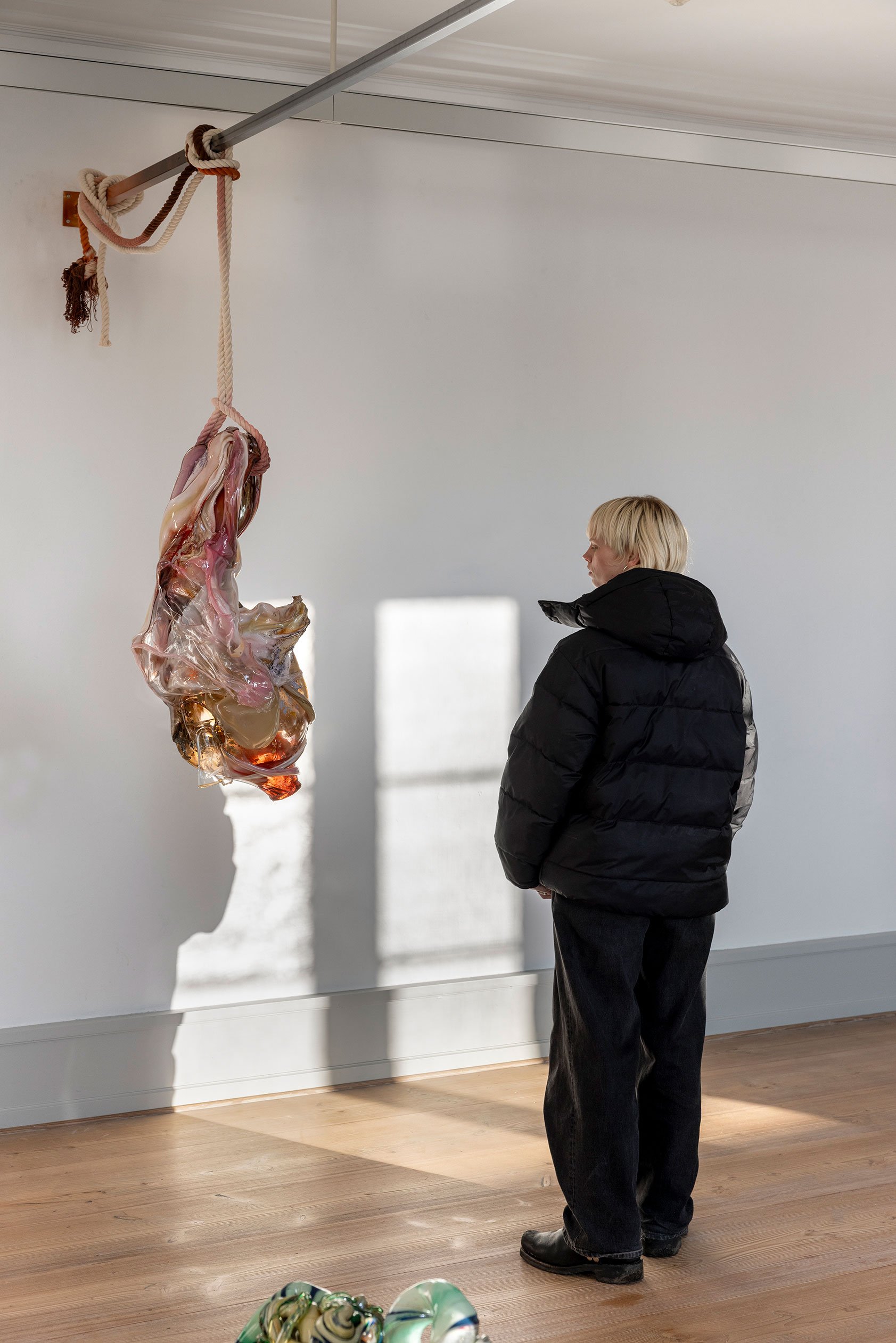
Maria Koshenkova: Fauns Flesh Vespertina from the exhibition Intuition Revolution at Sophienholm, 2026. Photo: Jan Søndergaard
The Loewe Foundation Craft Prize is one of the most significant international recognitions in contemporary craft and art. What does this nomination mean to you?
“It means a great deal – both as recognition and as a confirmation that glass can carry complex narratives about the body, identity, and experience. I work with glass as a fine art material. For me, it is a living medium through which I can explore transformation and organic forms in motion. On a personal level, the nomination marks an important point in my journey – from Russia to Denmark – and in my exploration of the body through material.“
I work with glass as a living material, sustaining a tension between body, transformation, and dissolution.
Maria Koshenkova
If you were to describe your practice in one sentence – what is it that you do?
“I work with glass as a living material, sustaining a tension between body, transformation, and dissolution.“
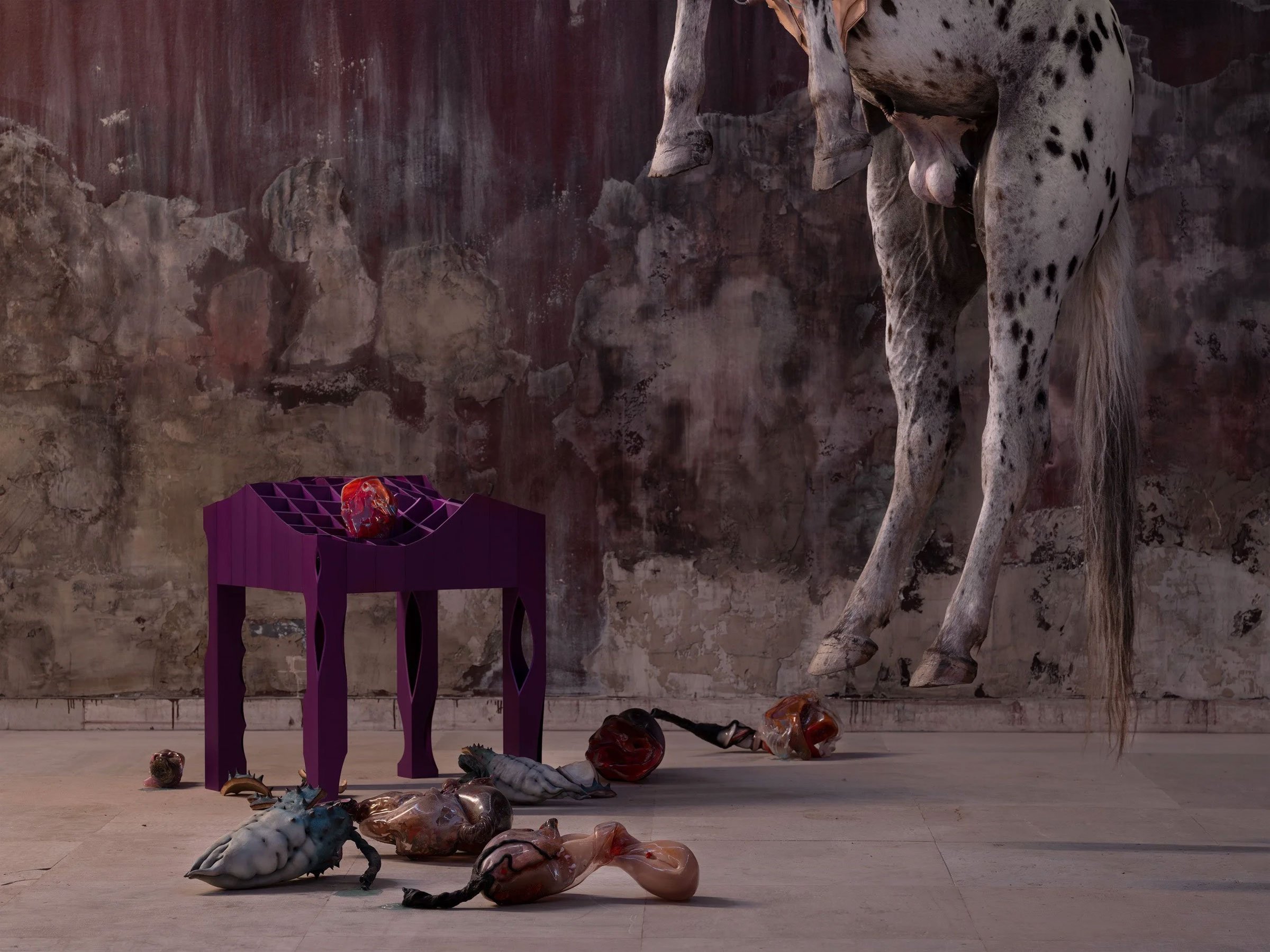
Contribution to the exhibition Uffe Isolotto, We Walked the Earth at the Danish Pavilion at the Venice Biennale in 2022. Photo: Ugo Carmeni
Your practice is highly physical. Where does it begin – in the body, in the material, or in a feeling?
“It begins as an intense energy within. As a child, I found a language for it through ballet – where the body became an instrument of tension, balance, and vulnerability. Later, there arose a need to translate this inner movement into form. In glass, I found a material where this can happen directly. It is both fluid and solid, fragile and strong. It is within this duality that I work with questions of identity, transformation, and desire.“
How do you see your practice in relation to the contemporary art field today?
“Glass has historically been positioned within craft, but I work with it as sculpture and fine art. I am interested in expanding the understanding of what glass can be – both formally and conceptually.“
Tell us about the work Faun’s Flesh
“Faun’s Flesh emerges from a personal experience of intense desire and attraction – an exploration of where the pulse begins and where it dissolves. The work moves beneath the skin and attempts to sustain a tension and a longing in constant transformation. It is not a figure, but a state.“
How did the work come into being?
“It began with a color – a deep, blood-red tone that seemed to rise from within the body itself. I worked with it in watercolor before it insisted on volume and became sculpture: stretched, tense, and alive – like a feeling in the process of becoming and dissolving.“
“I then selected colors – from recycled glass and new materials – in shades of yellow, white, and red with varying intensity. I began with a small, controlled bubble, where the color was built up in layers. This was where the work resided. As the form was blown, I disturbed it – pulling, twisting, and allowing gravity to work against it. I did not build a body. I sustained a tension.“
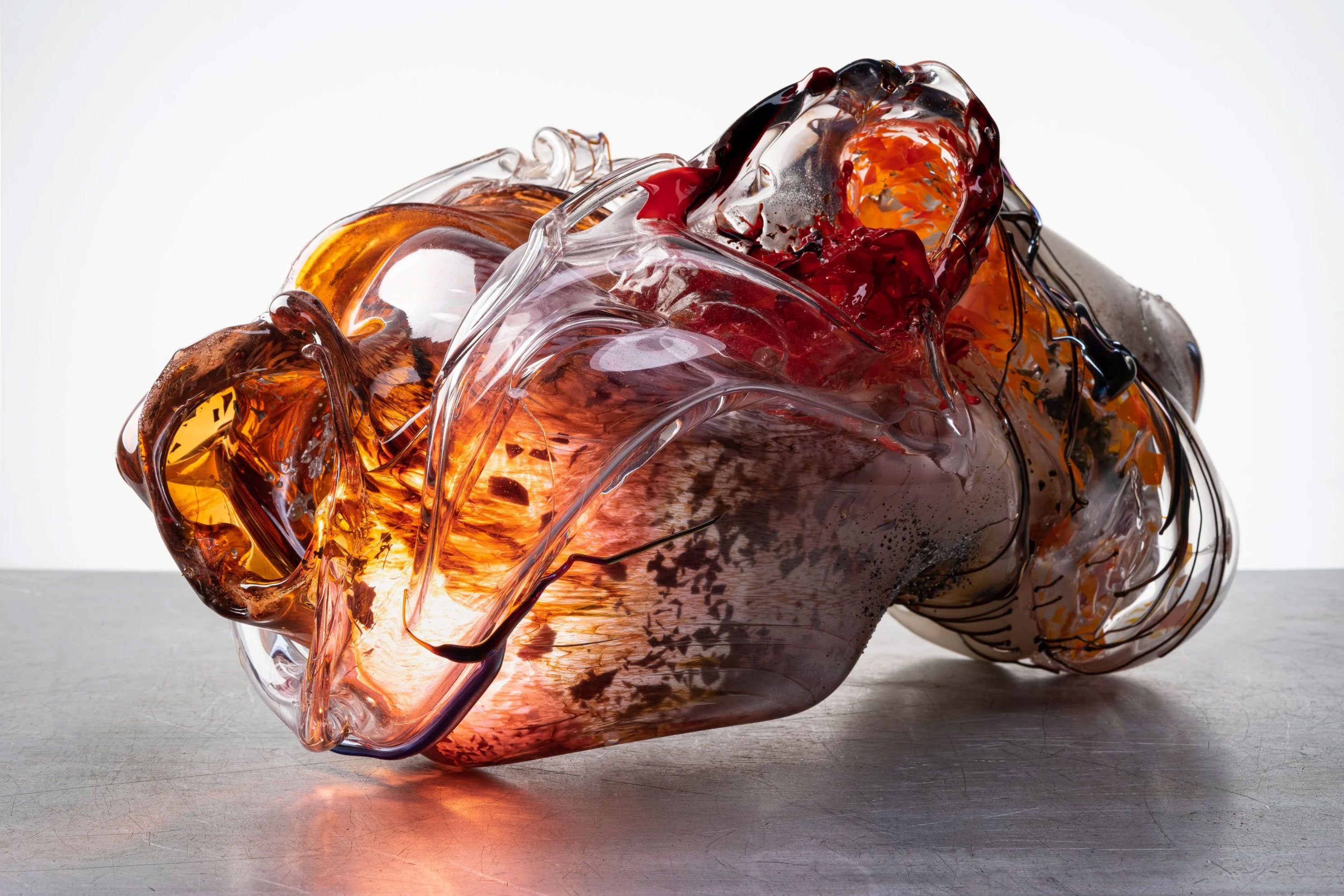
Maria Koshenkova: Faun’s Flesh I, 2023. Photo: Maxim Nesterov
“The work went in and out of the furnace six to seven times at around 1000 degrees, each time to continue the deformation. At a certain point, the glass became so tense that it could only be moved in short, precise intervals – at that stage, I worked extremely fast. After cooling, I cut and ground the surface to reveal the structure. Finally, I applied a thin layer of silver amalgam in selected areas. I worked with it like a form of ink, where the silver appeared fluid and semi-transparent, adding a subtle metallic quality to the surface.“
You work with both cast and free-blown glass. Why is it important for you to move between the two?
“Because they represent two different states. Casting is planned and controlled. Free-blown is moment and movement. I work with both, but it is in the unpredictable that something begins to happen. That is where the body emerges in the material.“
The work appears extremely physical, almost like a performance. How much is your own body involved?
“All the time. I work with pressure, rotation, and tempo, always together with a team of up to four people. At temperatures around 1000 degrees, we have to trust each other completely. For me, it is a form of choreography – not as staging, but as a physical necessity, where the body is in constant relation to the material.“
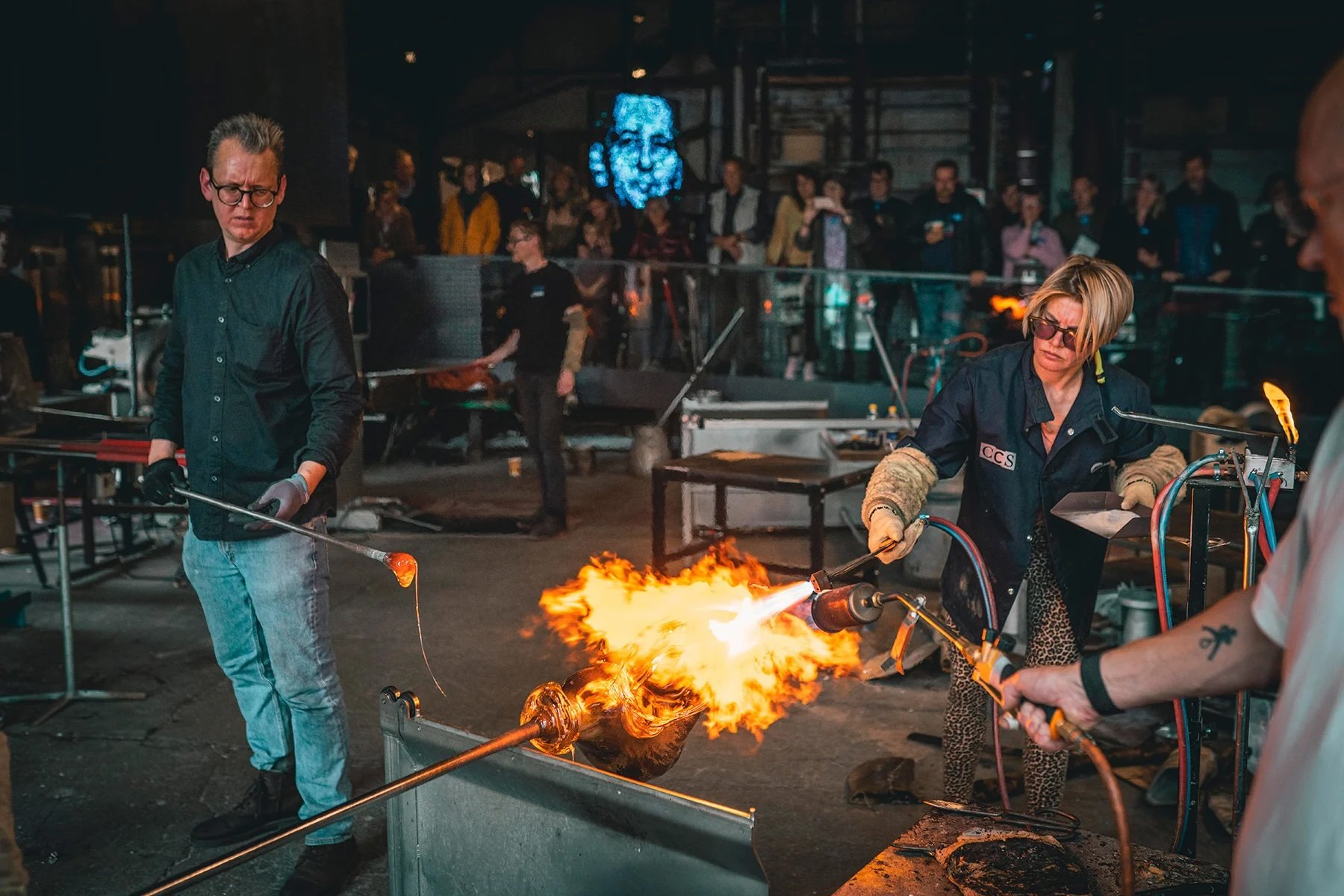
Maria Koshenkova together with Bjørn Friborg and Peer Sonny, both glassblowers at Holmegaard Værk. Photo: Mads Tolstrup / Museum Sydøstdanmark
How does working at Holmegaard Værk influence your practice?
“I have worked there since 2020. It is a place with a strong history and some of the most skilled glassblowers in Denmark. I still feel a sense of awe when I enter the workshop. At the same time, it allows me to work at a scale and complexity I could not achieve alone. The museum’s collection is a constant source of inspiration, and the surrounding nature influences my work more than I had expected.“
You work closely with glassblowers. How does that affect the making of the work?
“It is an essential part of the process. The work emerges in a shared space of precision and timing, where every movement matters. The collaboration allows me to push the material further than I could alone and creates an intensity in the process that is reflected in the work.“
I am interested in the body as something in constant transformation – something that can dissolve, stretch, and become porous.
Maria Koshenkova
Your works revolve around the body, but without being figurative. What is it you are exploring?
“I am interested in the body as something in constant transformation – something that can dissolve, stretch, and become porous. Something that holds both strength and vulnerability, desire and resistance. My sculptures exist between the anatomical and the abstract.“
How do you work with color – is it controlled or does it emerge in the process?
“I begin with a precise idea, but color always changes in the heat. It exists in layers, and small variations can alter the entire expression. It is a balance between control and chemistry – and a curiosity about what the material itself wants.“
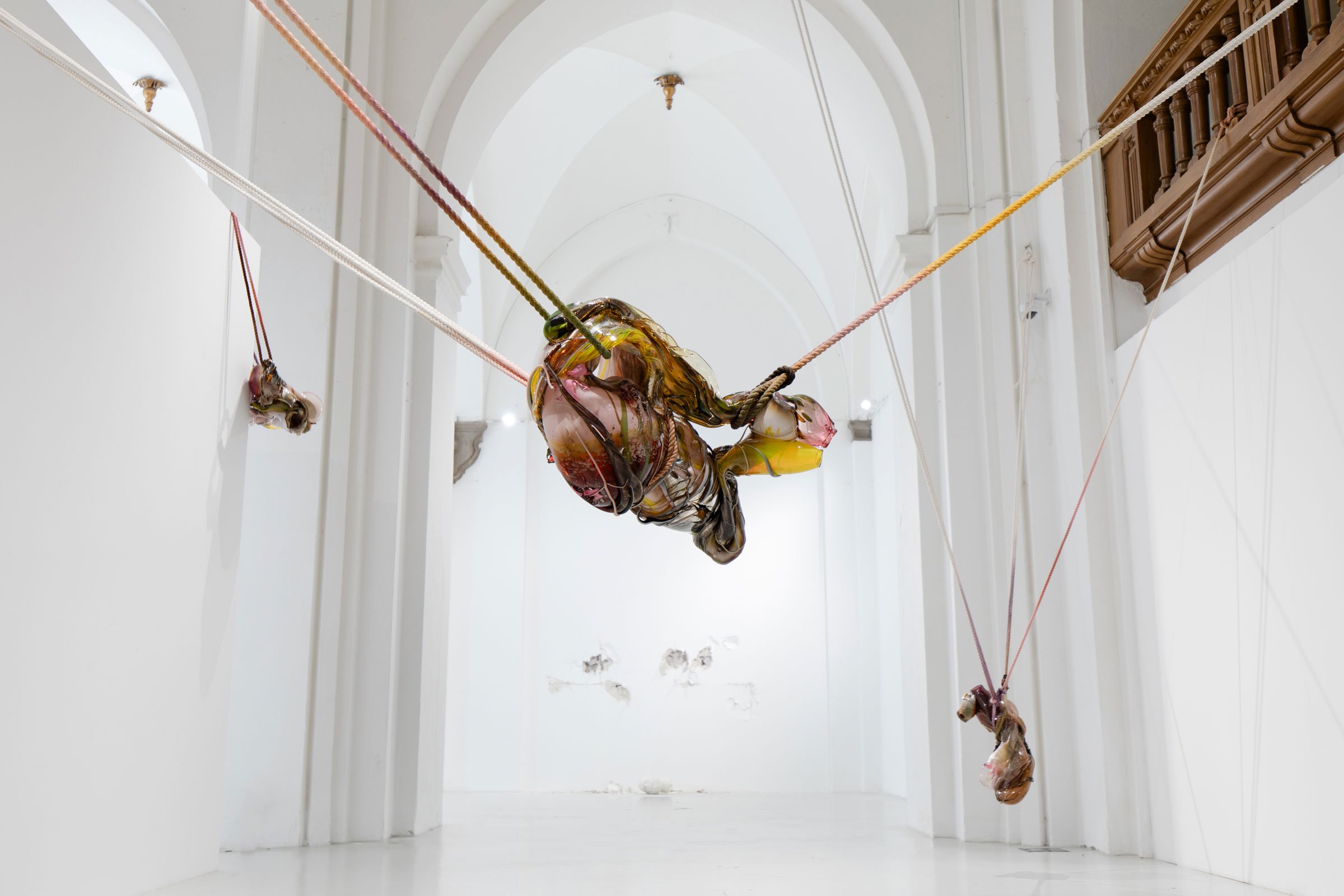
Installation view from the exhibition I’m Sorry, This Space Is Reserved at Nikolaj Kunsthal in 2024. Photo: Mads Holm
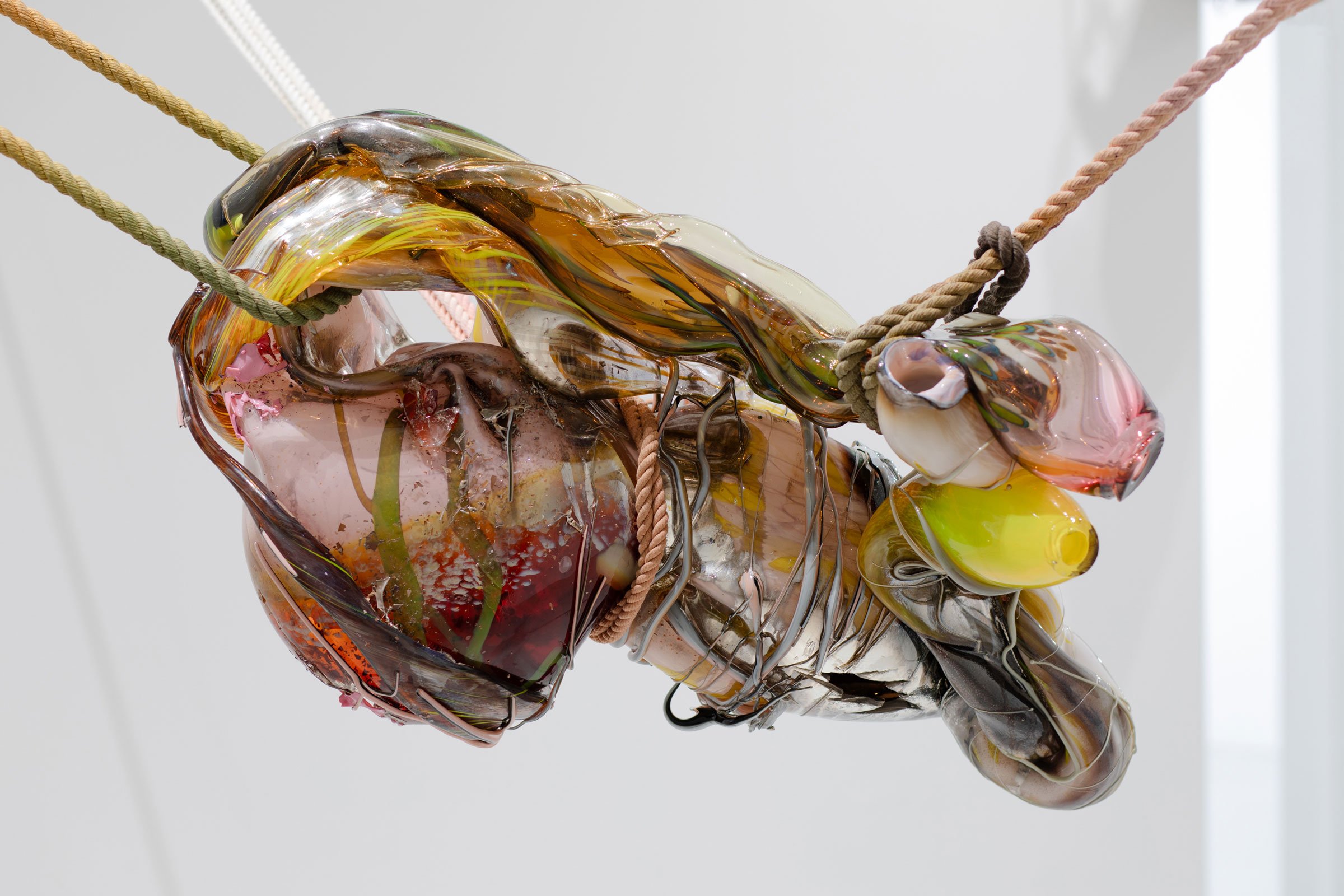
Installation view from the exhibition I’m Sorry, This Space Is Reserved at Nikolaj Kunsthal in 2024. Photo: Mads Holm
You also challenge how your works are installed. Can you describe your approach?
“The works function as an extension of the space. I always take the architecture as a starting point and often work with ropes that I dye myself, allowing the color to move between rope and sculpture. This creates a connection between the work and the space. The installations are not static but activate a vertical and bodily tension.“
You are currently showing works in the group exhibition Intuition Revolution. How did you work with intuition here?
“For me, intuition is a form of embodied knowledge shaped through experience. In this exhibition, I worked with pieces that emerged without a fixed plan, in direct dialogue with the material. Suspended in states of tension, they activate both the architecture and the viewer’s movement.“
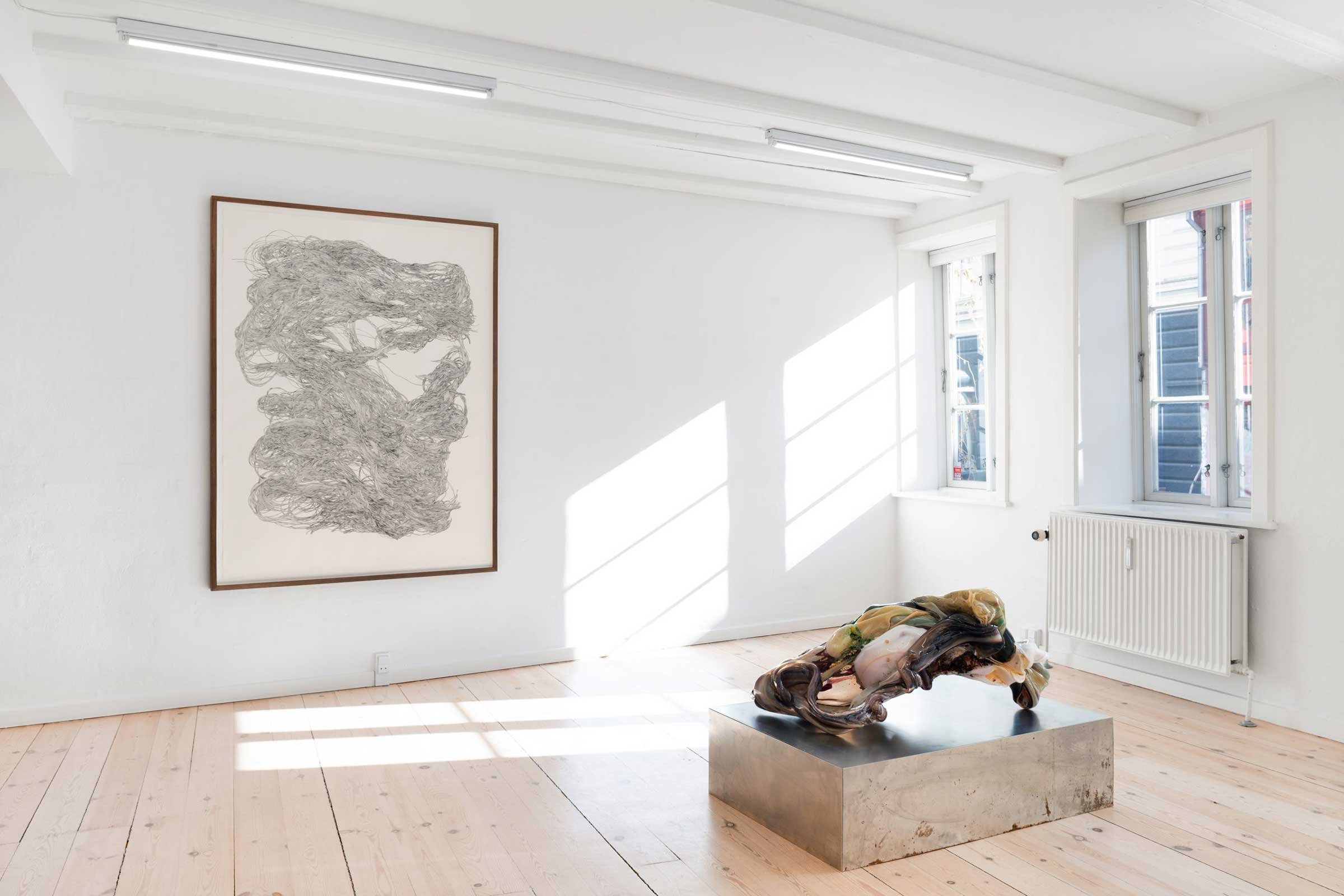
View from Maria Koshenkova and Nanna Riis Andersen’s exhibition Spændinger (Tensions) at Galleri Lene Bilgrav, 2026. Photo: Jacob Friis-Holm Nielsen
In the exhibition Spændinger at Galleri Lene Bilgrav, your sculptures are shown alongside drawings by Nanna Riis Andersen. What happens in the meeting between the two of you?
“We both work with the body – not as a figure, but as tension. Something that pulls, holds, and yields. It is as if the forms are always on their way somewhere, as if they could slip out of themselves.“
How do you think about your works in relation to the spaces they inhabit?
“My sculptures are not self-contained; they shift in character depending on how they are installed. What matters to me is that they activate something in both the body and the surrounding space.“
What are you working on right now – and what is the next step?
“My practice is expanding towards larger-scale works, with an increasing interest in the public realm. I am currently working on my most ambitious sculpture to date, investigating how tension and transformation can be articulated within an architectural framework.”
About Maria Koshenkova
Maria Koshenkova was born in Saint Petersburg in 1981. She is educated at the Saint Petersburg Stieglitz State Academy of Art and Design and The Royal Danish Academy – Glass & Ceramics. In addition, she has trained in glass art at Linnaeus University in Sweden. Maria Koshenkova has exhibited in Europe, Asia, and the United States and has received several awards and grants. She lives and works in Copenhagen and at Holmegaard Værk.