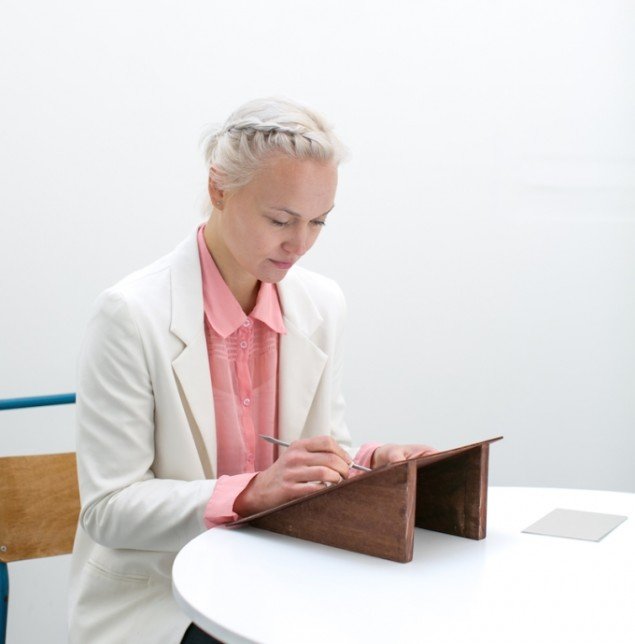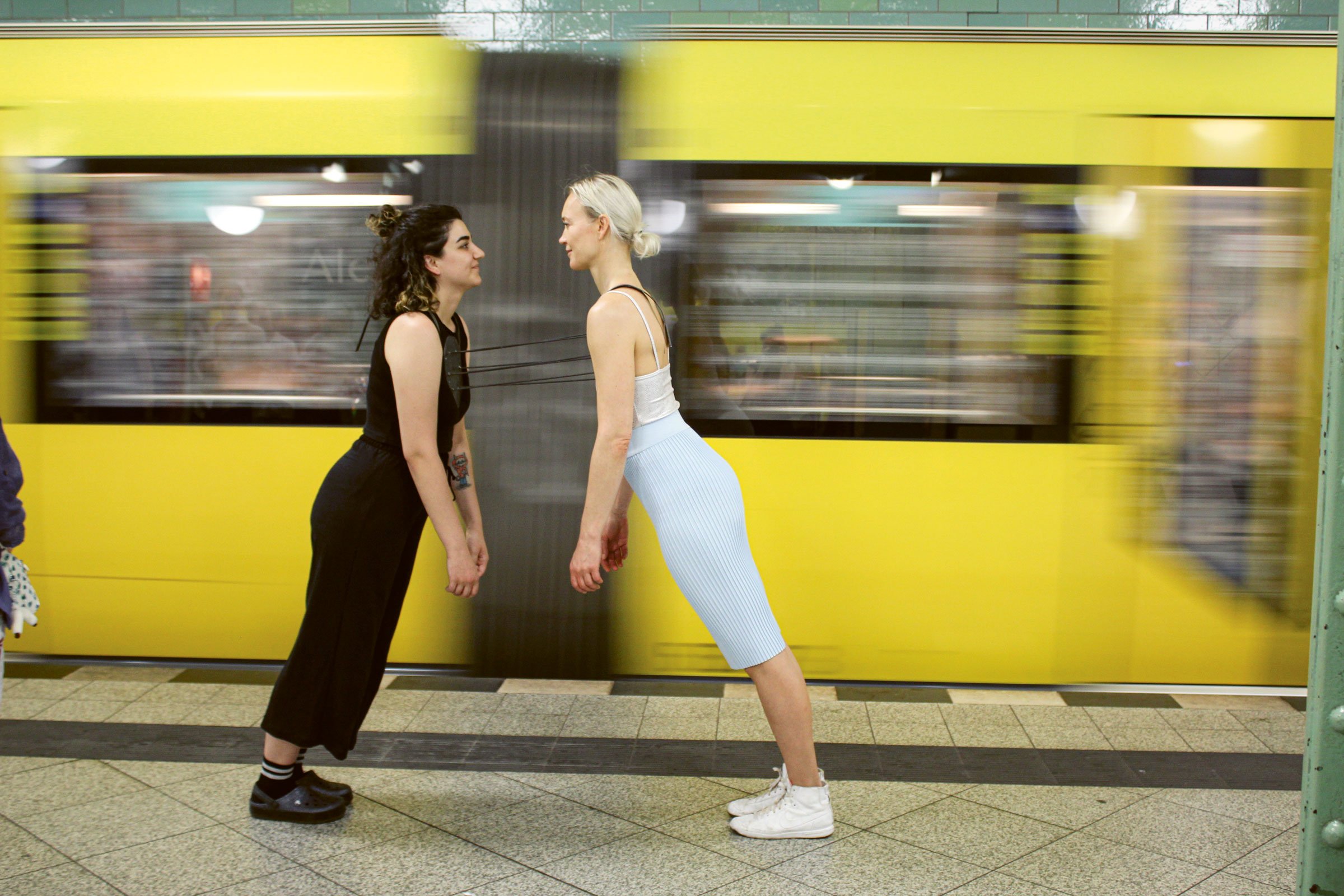
In the quiet spaces between breath and movement, Danish artist Sophie Dupont finds her voice. She navigates the realms of visual and performance art, weaving together painting, sculpture, photography and immersive installations. Her work is not merely seen; it is felt, experienced and lived.
(This interview is an excerpt from the publication Sophie Dupont – Breathe, published by Strandberg Publishing.)
Dupont’s artistic journey is deeply personal, rooted in a profound exploration of human existence. Her practice delves into themes of vulnerability, identity and transformation, often using her own body as both subject and medium. Through performative rituals and abstract expressions, she invites audiences to confront the essence of being, to pause and to breathe.
Trained at the Royal Danish Academy of Fine Arts and London Contemporary Dance School, Dupont’s multidisciplinary background informs her holistic approach to art-making. She has performed and exhibited internationally, sharing her work on stages and in galleries across Europe, Asia and the Americas, bringing her intimate explorations of the body, breath and emotion to audiences worldwide.
Yet beyond exhibitions and performances, Dupont’s art is a testament to resilience and introspection. It is a journey from abstraction to embodiment, from silence to expression, and from the personal to the universal. In her creations, she seeks not just to depict life but to breathe it into existence.
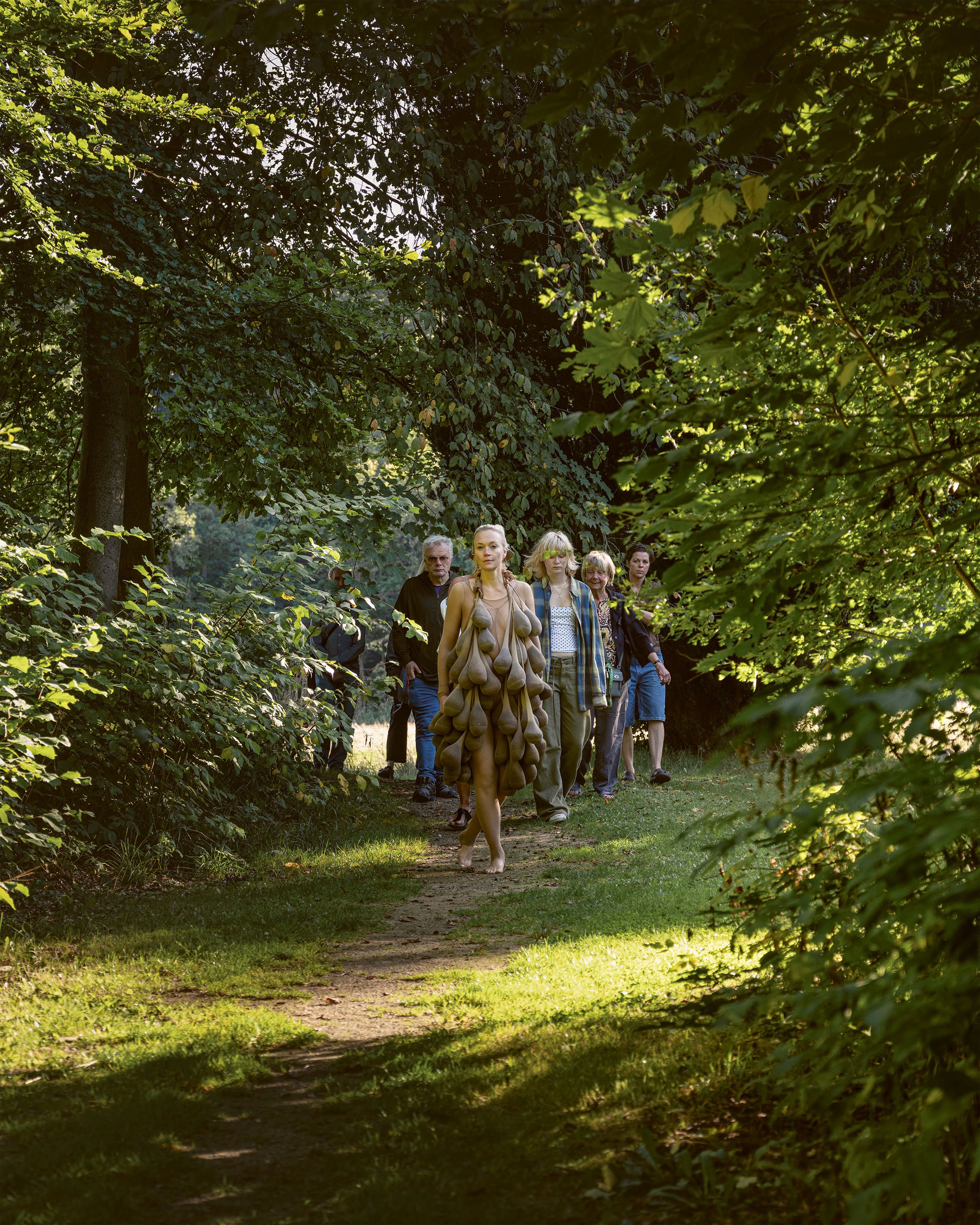
Sophie Dupont: My Weight in Soil Earth Breath Release, 2 September 2025, Flynderupgaard, Denmark. Photo: Sofus Graae
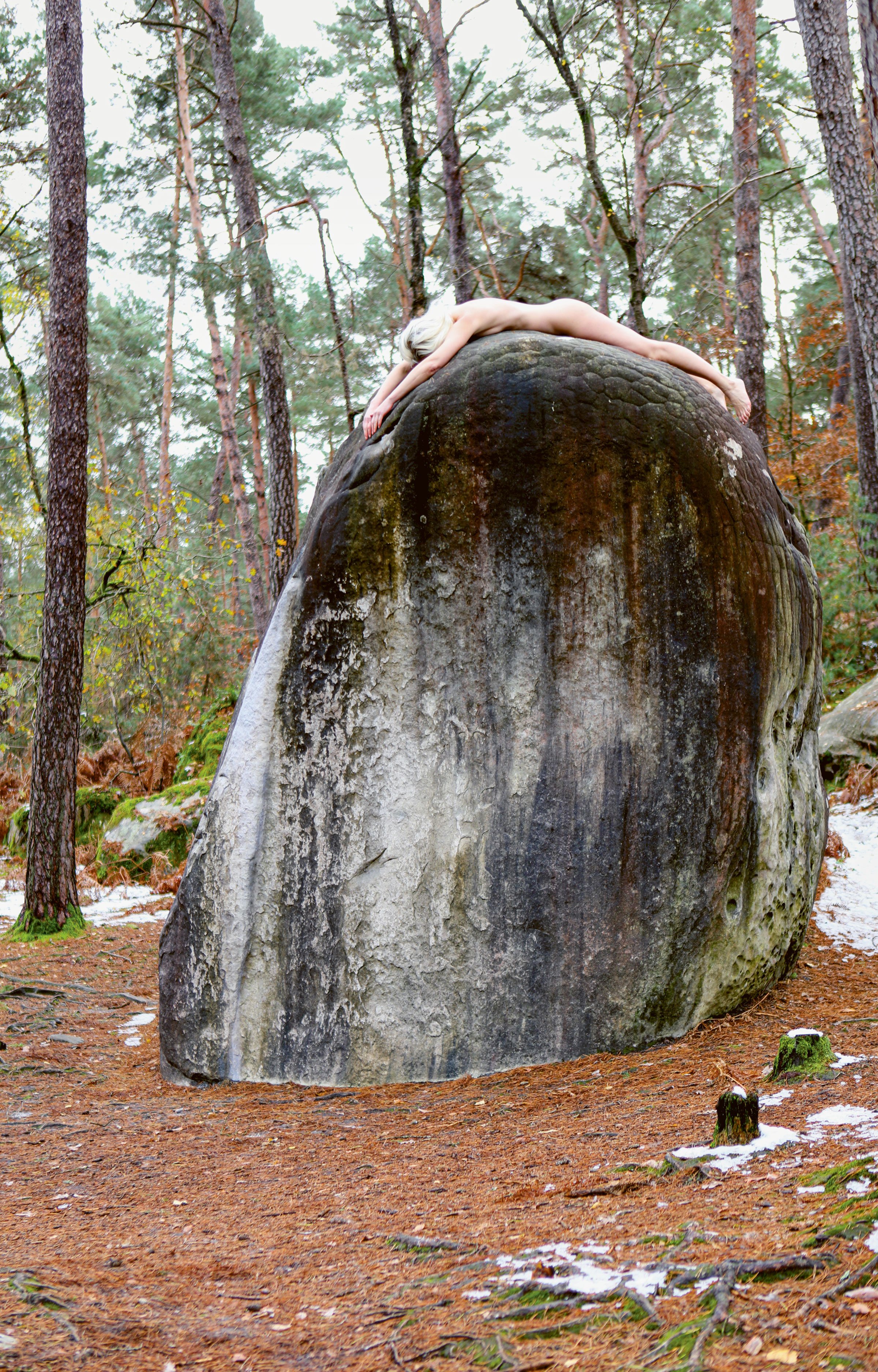
Sophie Dupont: Connecting, 23 November 2024, Forêt de Fontainebleau, Frankrig. Photo: Thierry Forien
Your work seems deeply connected to your own experiences and emotions. How did the challenges and stories from your life guide the way you developed your artistic language?
“I see my art as humanistic and feministic; overall it’s about human experience, not just gender. But of course, my perspective and struggles as a woman inevitably influence what I create. I spent a long time trying to find a language that felt authentic, one that could be accepted on its own terms. My life has been so coloured by psychology and many difficult personal stories that, at some point, I became a little tired of stories. When I began exploring new forms, I started combining abstract painting with unexpected elements – machines, creatures, mixes of history – creating strange, hybrid worlds. I think this approach reflects my desire to work beyond stories and narratives, which had dominated much of my life. I wanted to reach a place where I could engage with the essence of life itself: something more elemental, something I could feel and breathe. In this way, my practice became about exploring everything and nothing at once, finding a language for life’s core experiences rather than just its stories.“
How did your background in both visual arts and contemporary dance shape your interdisciplinary practice?
“For me, dance was always a way to connect and to express myself beyond words. It was an outlet, a form of emotional expression that worked on every level. Contemporary dance, in particular, demands a deep connection to the body and combines discipline with freedom – learning, training, and ultimately letting go.“
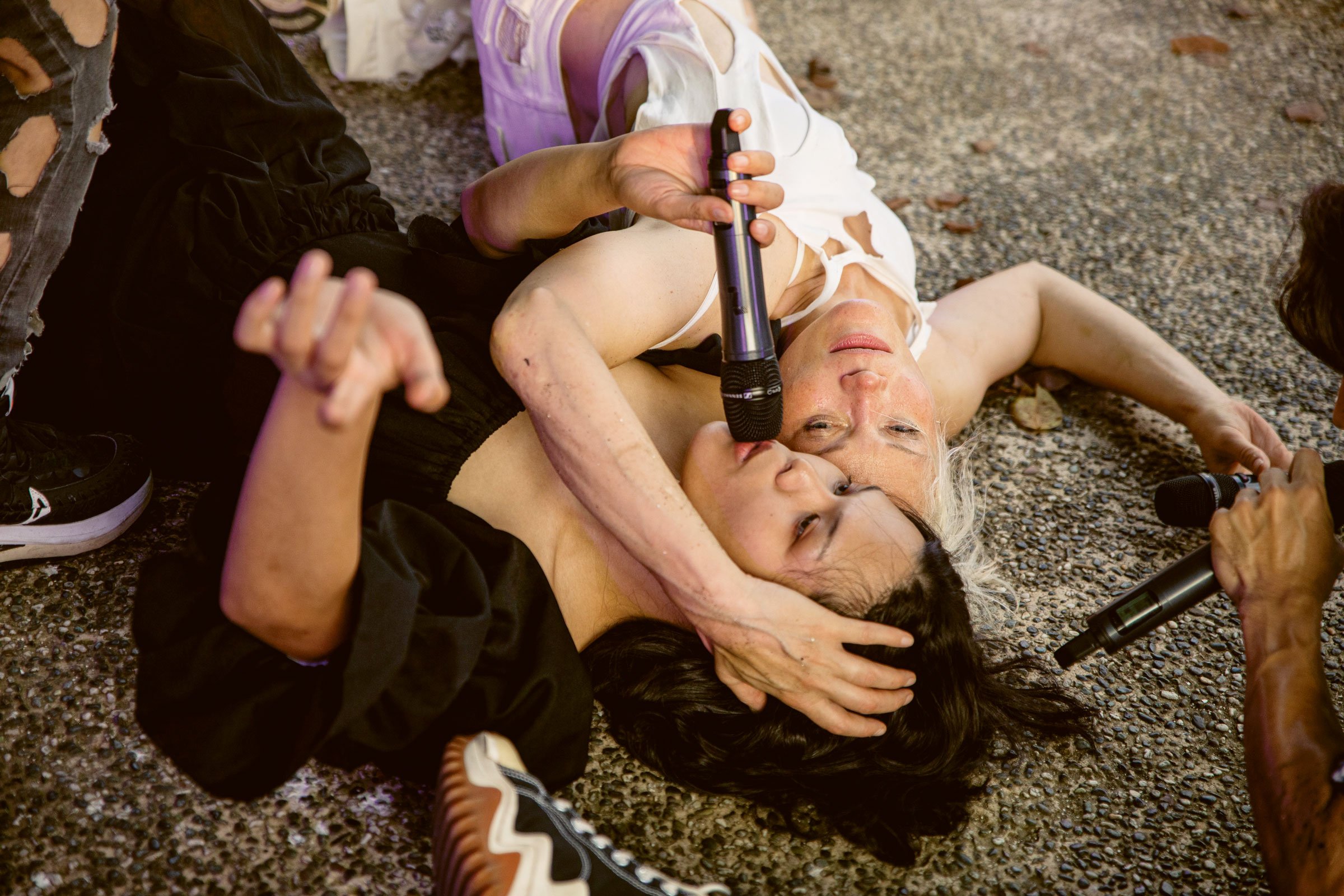
Sophie Dupont: Breathing Beings, 17 October 2024, Manila, Filippinerne. co-performer: Christine Crame. Photo: Geric Cruz
“Later, when I turned towards visual arts, I brought these same sensibilities with me: awareness of space, rhythm and emotional resonance. The physicality of dance and the emotional weight of music carried over into my visual practice, creating a dialogue between body, emotion and visual form. This interdisciplinary approach allows me to explore ideas holistically, connecting movement, sound and image into a single creative language.“
You can hold your breath, or breathe in many different ways, but breath itself is universal and truthful.
Sophie Dupont
What influenced your decision to use your body – and breath – as your primary material? Your performances often centre on the act of breathing. What inspired this ritual?
“You can hold your breath, or breathe in many different ways, but breath itself is universal and truthful. We all understand it instinctively: if someone is struggling to catch their breath, we immediately sense that something is wrong. And we can also tell whether it is authentic or performed. That honesty – something so simple and direct – is what drew me to use breath as my primary material.“
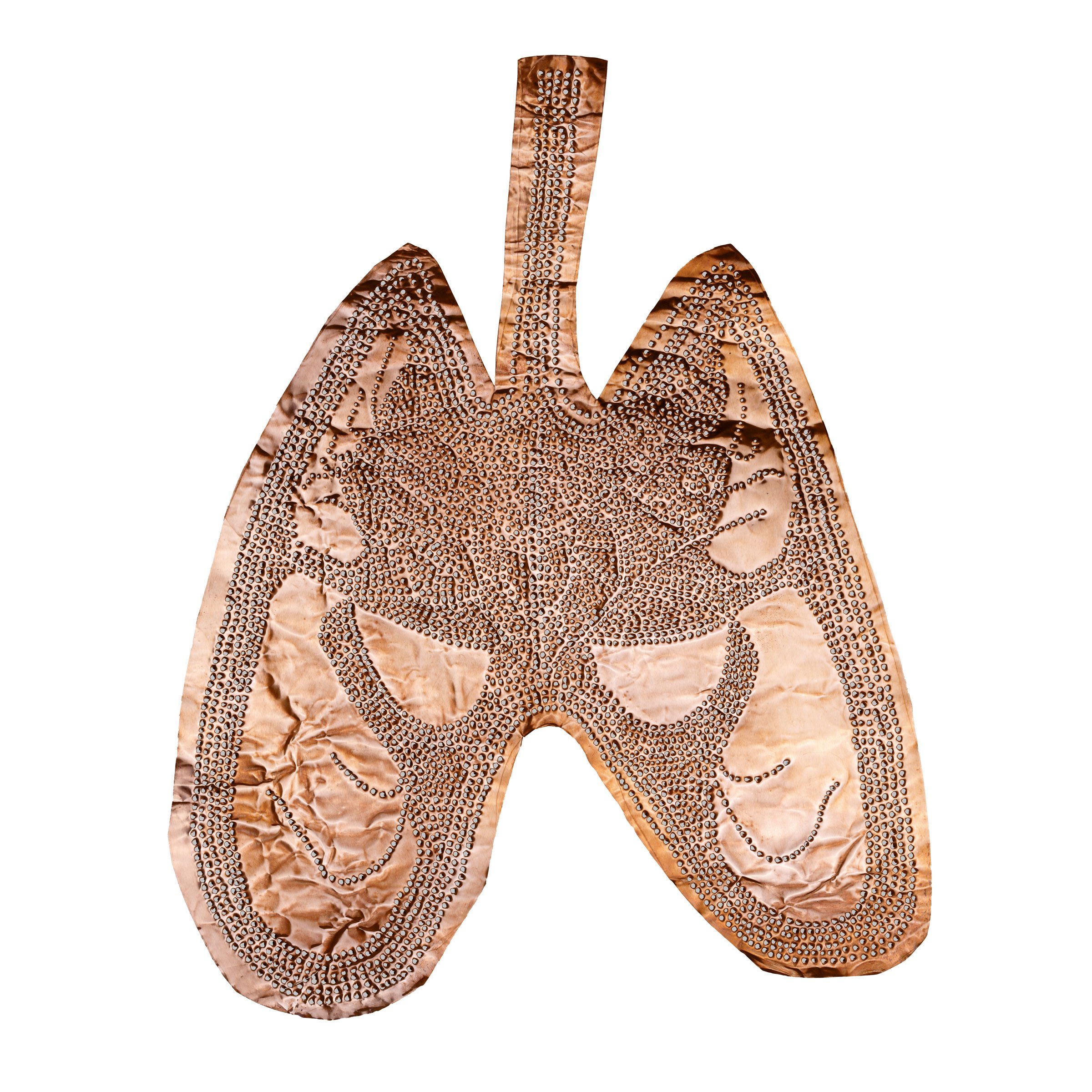
Sophie Dupont: Cobber lung, 2019. Photo: Sofus Graae
“My grandmother, who was a doctor, taught me an essential lesson early on: if you struggle to inhale, first exhale completely, and then you will be able to breathe in. This became more than a technique: it became a metaphor and a practice, a way to reconnect with life and the body at its most elemental level.“
“By centring my performances on the act of breathing, I discovered a form of expression that is both deeply personal and universally accessible. My background in dance gave me the tools to understand the body as material, while my engagement with visual art encouraged me to ritualise and frame these gestures. Breath became the bridge: a simple, elemental act that carries memory, trauma and transformation while also opening a space for connection with others.“
A world without breath would be nothing but a confused mass of objects in the process of decomposition. It is thanks to breath that we are in the world, it is in and through breath that we have understood and fashioned the world. It is of breath that we have to enquire about the nature of the world: it is in breath that the world reveals itself, it is in breath that the world exists for us.
Emanuele Coccia, <em>The Life of Plants</em>, 2017
Let’s talk about some of your specific works. For instance, in your 2011 piece Marking Breath, you spent an entire day silently carving lines into panels with each exhale. What first drew you to working with breath in this way, and how did that initial exploration evolve into a work you’ve now performed in over thirty places around the world?
“During my studies in London, one of my greatest interests was Rudolf von Laban. He developed a system for the notation of movement, and I was fascinated by the idea of translating movement into a minimalistic notation system. This concept deeply influenced the way I began to think about the body and breath.“
“I started wondering, how could I apply a similar approach to breathing? My dance education, combined with practices like yoga, had already made me very familiar with controlling the breath. I had also, from a very young age, developed a strong personal relationship with breathing.“
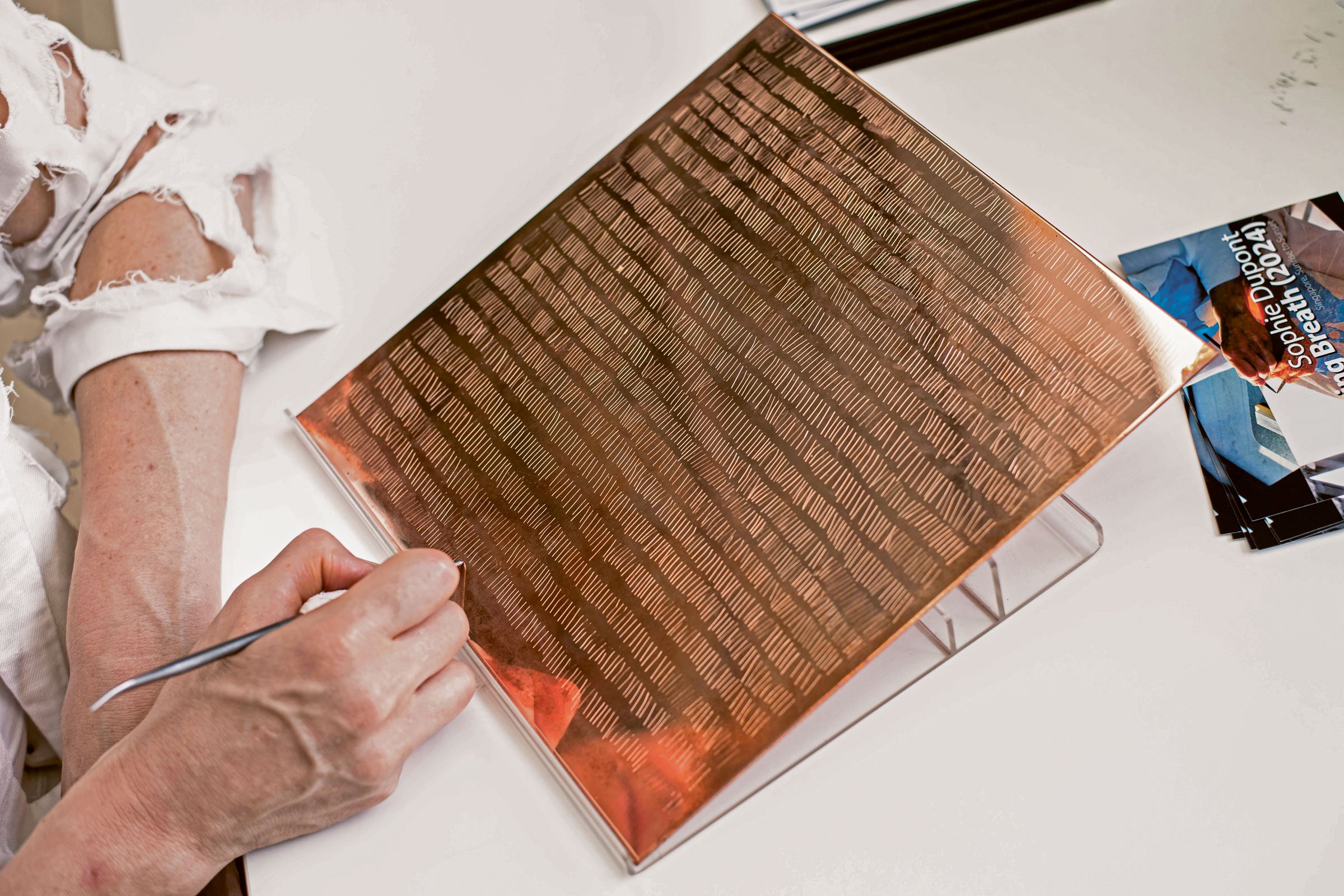
Sophie Dupont: Marking Breath, Sunrise to Sunset
5 April 2024, 7:03-19:11. Cobber. Photo: Ken Cheong
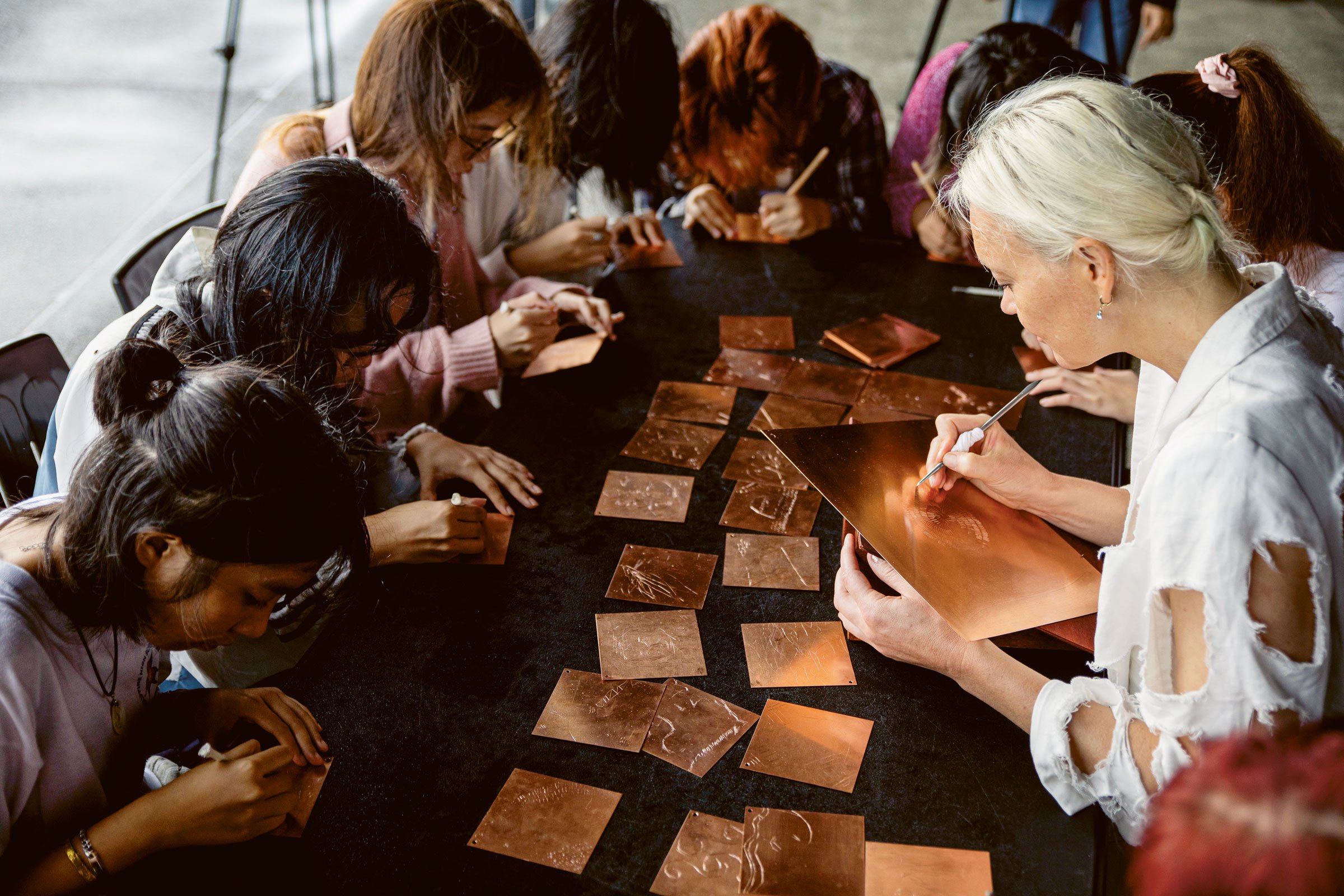
Sophie Dupont: Marking Breath, Sunrise to Sunset 15 october 2024. Mount Makiling, Philippines. Copper. Fotos: Geric Cruz
“In 2009, I began experimenting with a kind of notation of breath, inspired by Laban’s method. Just as he translated bodily movement into visual symbols, I started exploring ways to visualise and record the subtle rhythms and qualities of breathing – turning something invisible into something tangible and expressive.“
“When I started working on the notation of breath, I saw a connection with Agnes Martin, whose work I have always admired. Of course, our works are very different, but there was a similarity in language coming from different places, and I found that deeply inspiring.“
“In the beginning, I would record my breath for twenty minutes, then an hour, sometimes two hours – just pencil and paper. Then, for an exhibition in Fifth Floor, Copenhagen, I transferred the work onto the wall with pencil. That was the first time I did it on a large scale, and I worked on it all day long, from sunrise to sunset.“
You can get bored by doing the same thing over and over, but for me that repetition became a point of reflection and inspiration.
Sophie Dupont
When you perform, you often invite the audience to join in. How did you come to involve others in your breath-based practices, and what does that shared experience add to your work?
“You can get bored by doing the same thing over and over, but for me that repetition became a point of reflection and inspiration. When I first started focusing on breath in my practice, people sometimes thought I was crazy – paying attention to only breathing. But to me, this is the base of our lives: we are always within ourselves, always breathing, even as we speak, eat, dance or interact with others.“
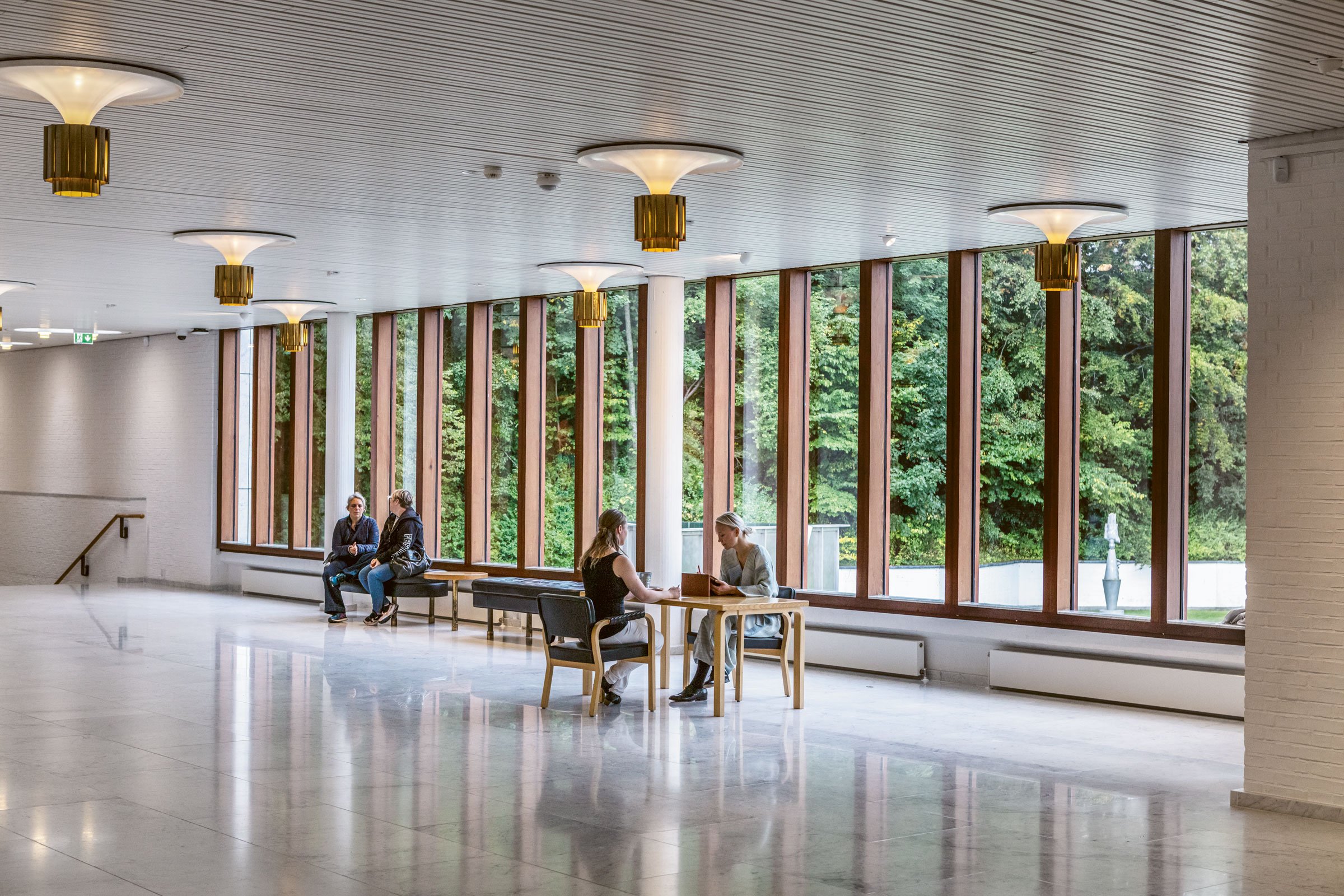
Sophie Dupont: Marking Breath, Sunrise to Sunset 20 September 2020, Kunsten Museum of Modern Art, Aalborg, Denmark. Photo: Niels Fabæk
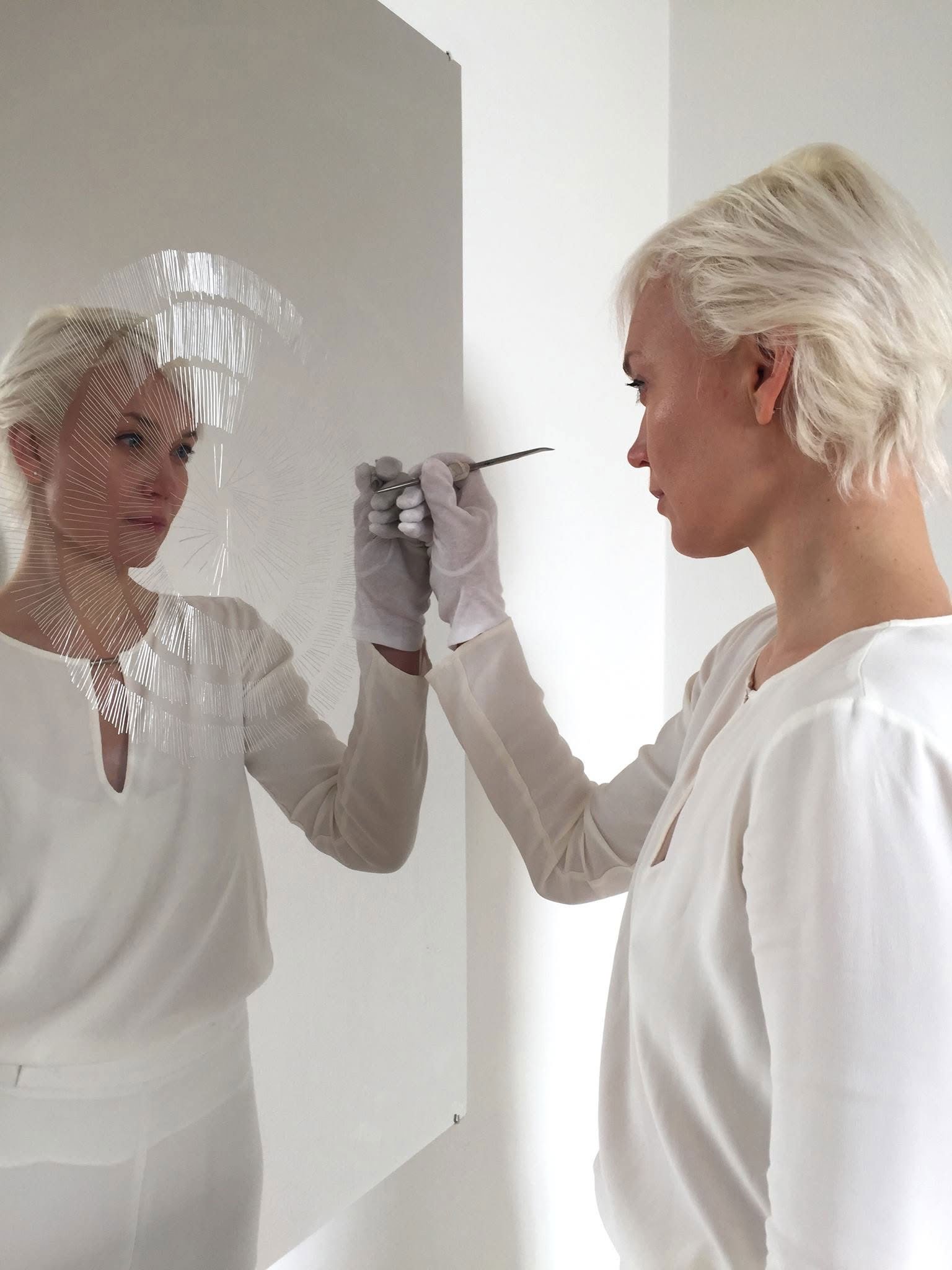
Sophie Dupont: Marking Breath, 2017. Photo: Therese Maria Gram
“When I began marking breath in public, it wasn’t to say, ‘Look at my breathing; it’s fascinating.’ It was to draw attention to a universal, shared act. Over time, I realised that people were intrigued and wanted to participate. That’s when I started inviting them to join in. Because breath is not just mine; it’s everyone’s. It’s a shared, collective experience, and allowing others to be part of it transforms it from a personal practice into a communal one.“
“Breathing is the first autonomic act we perform at birth, and it is the last one at the end of life. In this way, breath frames our entire existence. It carries not just life itself but also cultural, spiritual and symbolic meaning. That awareness has deeply informed my work, turning something so ordinary and automatic into a profound medium for artistic exploration.“
You’ve called breath a universal language. How does it create connection between people in your performances?
“For me, breathing represents a horizontal way of communicating, a language that places everyone on the same level. In performances such as I BREATHE YOU DO YOU BREATHE ME?, where participants focus on their own breath and begin to listen to each other, you can clearly see this unfolding. At first, people might feel tense, but as they begin to relax and tune in to their breathing, they also start to engage and interact with one another in subtle but powerful ways.“
“The breath grounds us in the present; when you bring awareness to breathing, you enter a state of presence. This presence can even liberate you from the emotional state you’re in at that moment, because you are simply here, now, with others.“
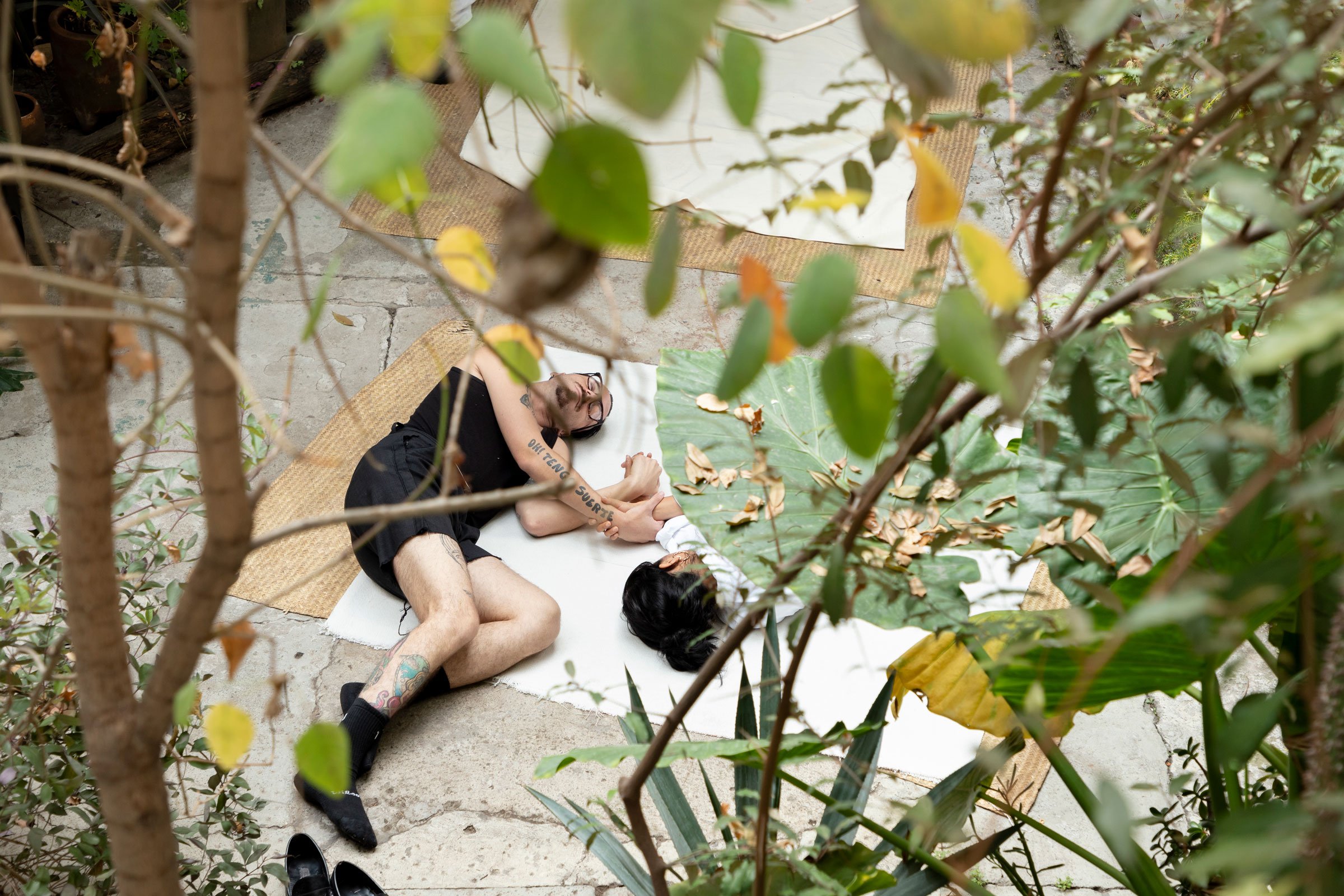
Sophie Dupont: I Breathe You, Do You Breathe Me?, Mexico City 2022. Photo: Aimée Suárez Netzahualcóyotl
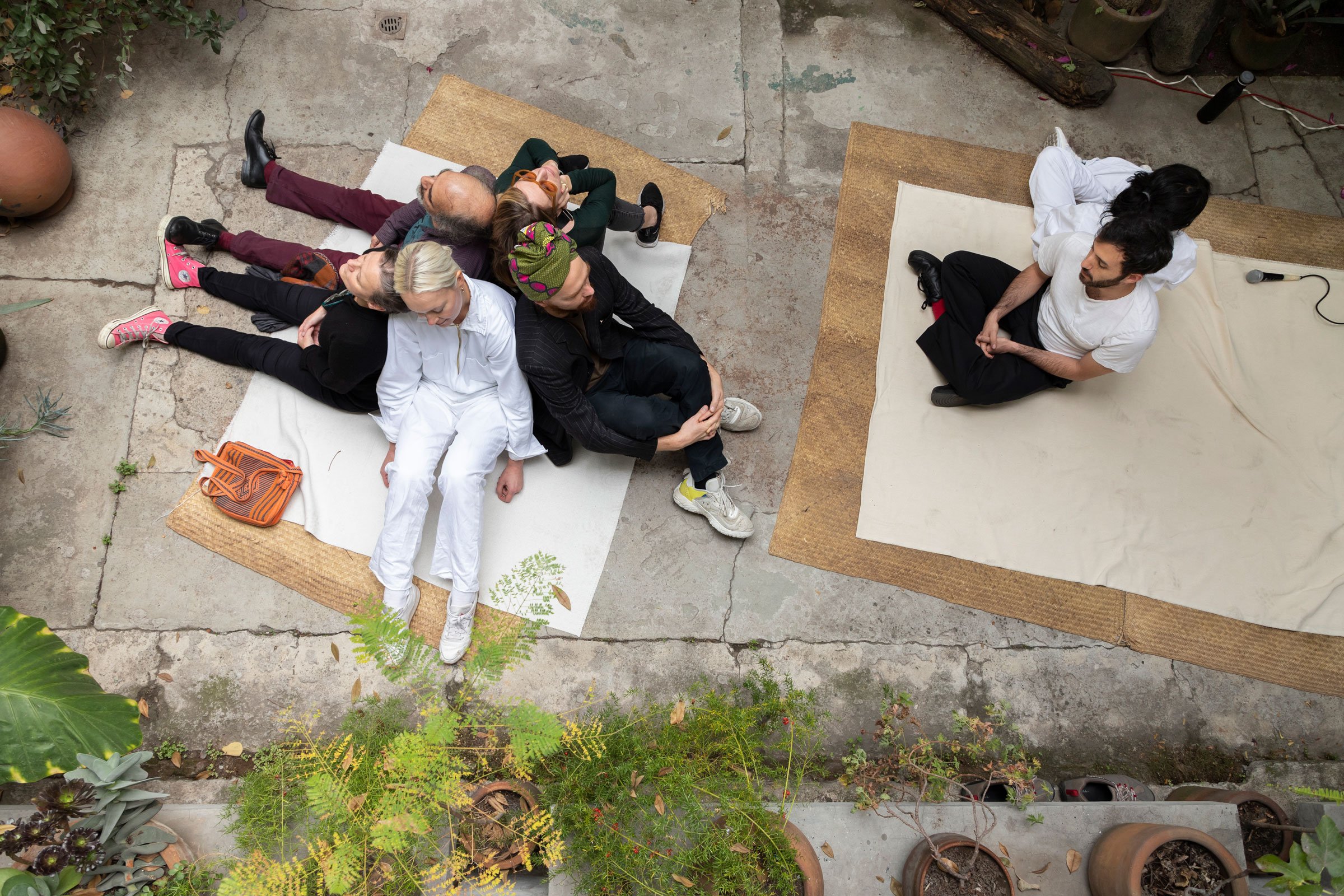
Sophie Dupont: I Breathe You, Do You Breathe Me?, Mexico City 2022. Photo: Aimée Suárez Netzahualcóyotl
“During these performances, some participants may breathe in a shallow or difficult way, reflecting their inner state. Yet everyone present immediately understands it. Breath does not require translation; it is not about personal stories or words, which can be heavy, complicated or guilt-inducing. Instead, breath communicates essence. The feeling of difficulty, of release, of joy, it is all conveyed through breathing in a way that everyone can contain and connect to.“
“This is the beauty of breath: it is a universal language. It transcends culture, age or personal history. It can hold pain, but it can also turn playful or funny in an instant. Breath creates a shared movement of energy – small, subtle changes that are immediately understood by everyone present.“
Your recent performance in Paris on 21 June 2025, titled REST. Paris. Solstice., took place near the Palais de Tokyo, specifically in front of the Trocadéro Gardens. This performance was held on the summer solstice, the longest day of the year, and served as both a performance and a ritual. It seems to blend activism and a critique of societal pressure. Do you consider your art a form of activism?
Yes, I do see it as a form of activism, though of course a very different kind.
Sophie Dupont
“Yes, I do see it as a form of activism, though of course a very different kind. When we look at the stressful environments many people live in, particularly in Western countries, it’s clear that our society – capitalist, fast-paced and demanding – creates pressure on our bodies and minds.“
“I am referring not only to the environment around us, such as mountains or forests, but also to our own bodily rhythms: breathing, resting, sleeping. Many people suffer from insomnia, stress and the constant push to produce more, move faster and achieve more than perhaps they truly need.“
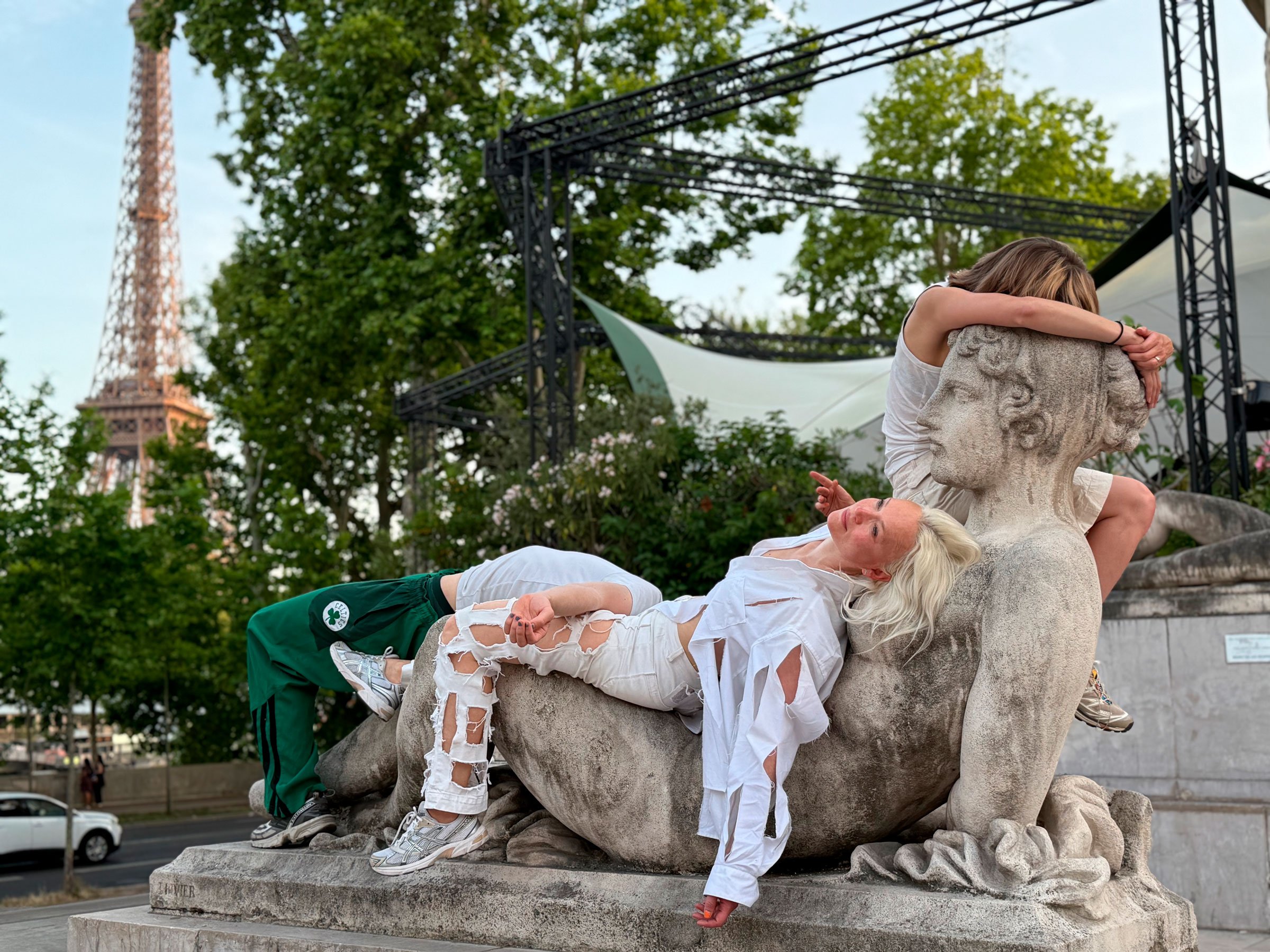
Sophie Dupont: REST. Paris. Solstice, 21 June 2025. Photo: Bar Mayer
“I began to call my work activistic because, for me, it is about reclaiming the breath: insisting that we take time to breathe, to rest, to truly feel ourselves. It’s about living fully in three dimensions, not just existing in a network or a flat, two-dimensional space (the screens). My work advocates for a real emotional life, an inner life and a physical being that must be engaged, felt and lived.“
On the International Day of Peace last year, 21 September, you performed Breathing Peace at Rådhuspladsen (the Town Hall Square) in Copenhagen. It was part of CAFx – Copenhagen Architecture Biennial. How did the performance go, and what was the experience like for you?
“This performance was something deeply personal to me. In a world shaken by war, division and unrest, I wanted to offer something simple, something essential, something human: the breath. Breathing Peace was a durational performance marking International Peace Day. From sunrise to sunset, Rådhuspladsen became a kind of collective lung: a living, breathing sculpture made of bodies in presence. Together, we inhaled and exhaled peace – for ourselves, for each other and for the world. Participants walked slowly in a circle, breathing together in rhythm. One by one, each person stepped into the centre and drew a line outwards from their body, like rays of a sun. A shared mark of care, presence and peaceful resistance.“
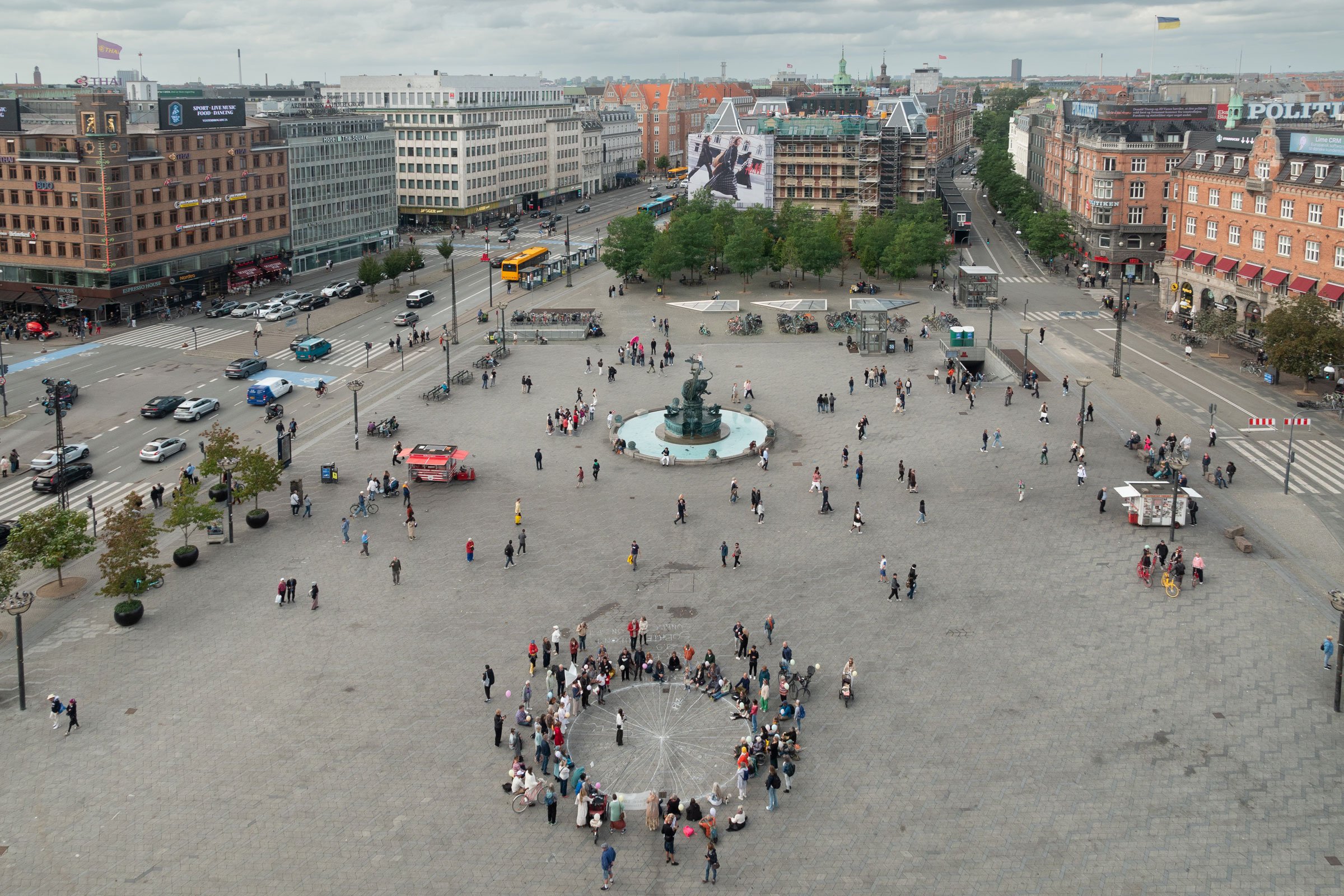
Sophie Dupont: Breathing Peace. International Day of Peace 21 September 2025. Sunrise to Sunset (6:53-19:11). CAFx. Photo: Bar Mayer
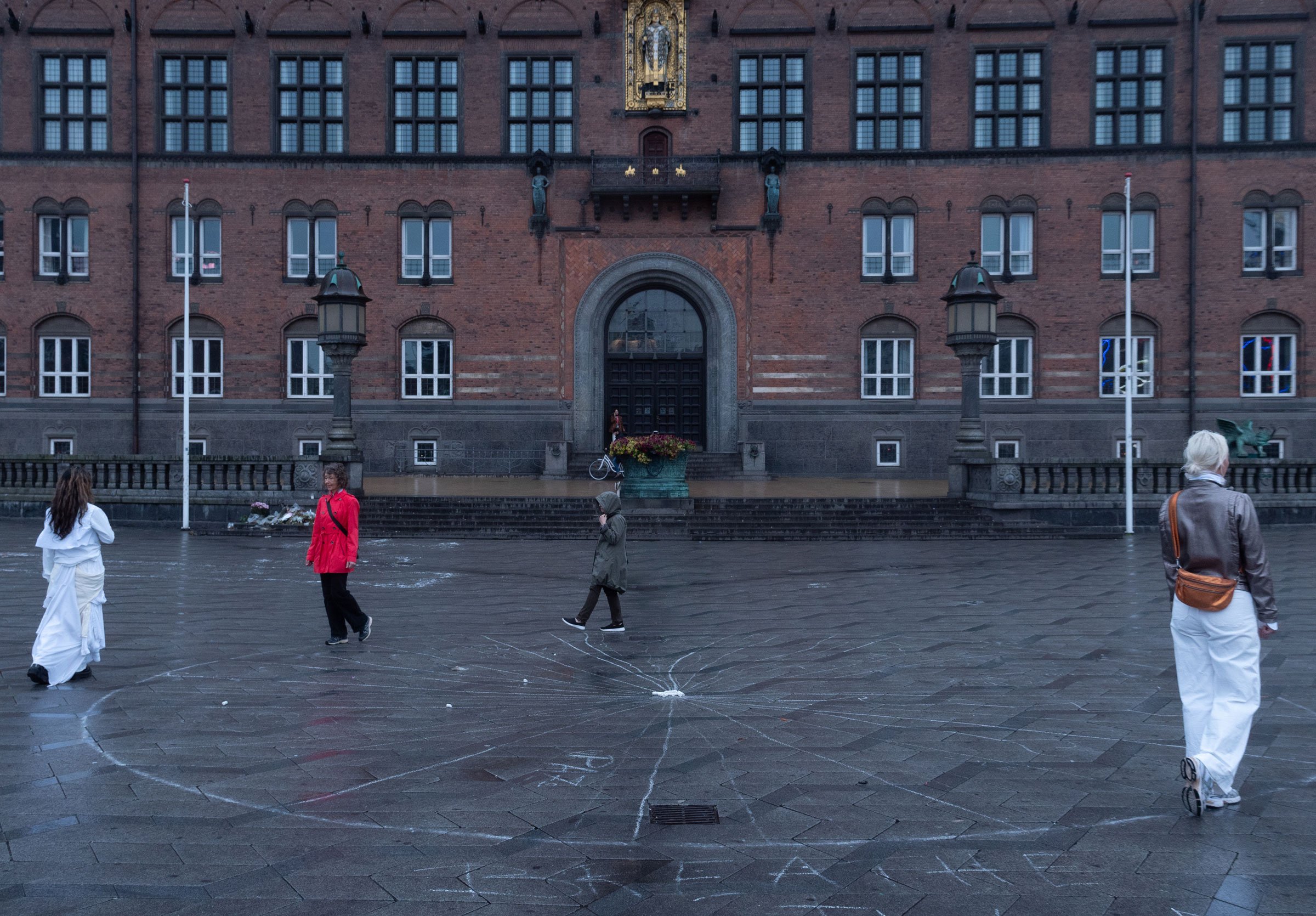
Sophie Dupont: Breathing Peace. International Day of Peace 21 September 2025. Sunrise to Sunset (6:53-19:11). CAFx. Photo: Bar Mayer
“Breathing Peace was not just a performance; it was a return, like Marking Breath. A return to the body, to slowness, to softness, to the possibility of healing, both personal and collective.“
“Throughout the day, the weather shifted; rain fell, the sun broke through, winds moved between cold and warm. People joined, some hesitantly, others with calm curiosity. Some asked questions, others simply breathed. In the last two hours before sunset, my friend and fellow artist Zara Wall arrived, singing a haunting political song, its lyrics holding hidden messages from women, carried softly through the rain. We walked in the rain. By the end of the day, a few people remained – still walking, still breathing peace, despite the cold and wind and pouring rain. It was touching.“
Breath contains everything: order, chaos, harmony, revolt, sorrow, joy, humour, gravity, anger. All these emotions and inner states intermingle and find expression in our being through this small rhythm that comes and goes. A rhythm that is life. Life – which keeps us afloat, from our first independent inhalation to our very last exhalation.
Sophie Dupont